
A Practical Reference Guide to Common Fitness Terms

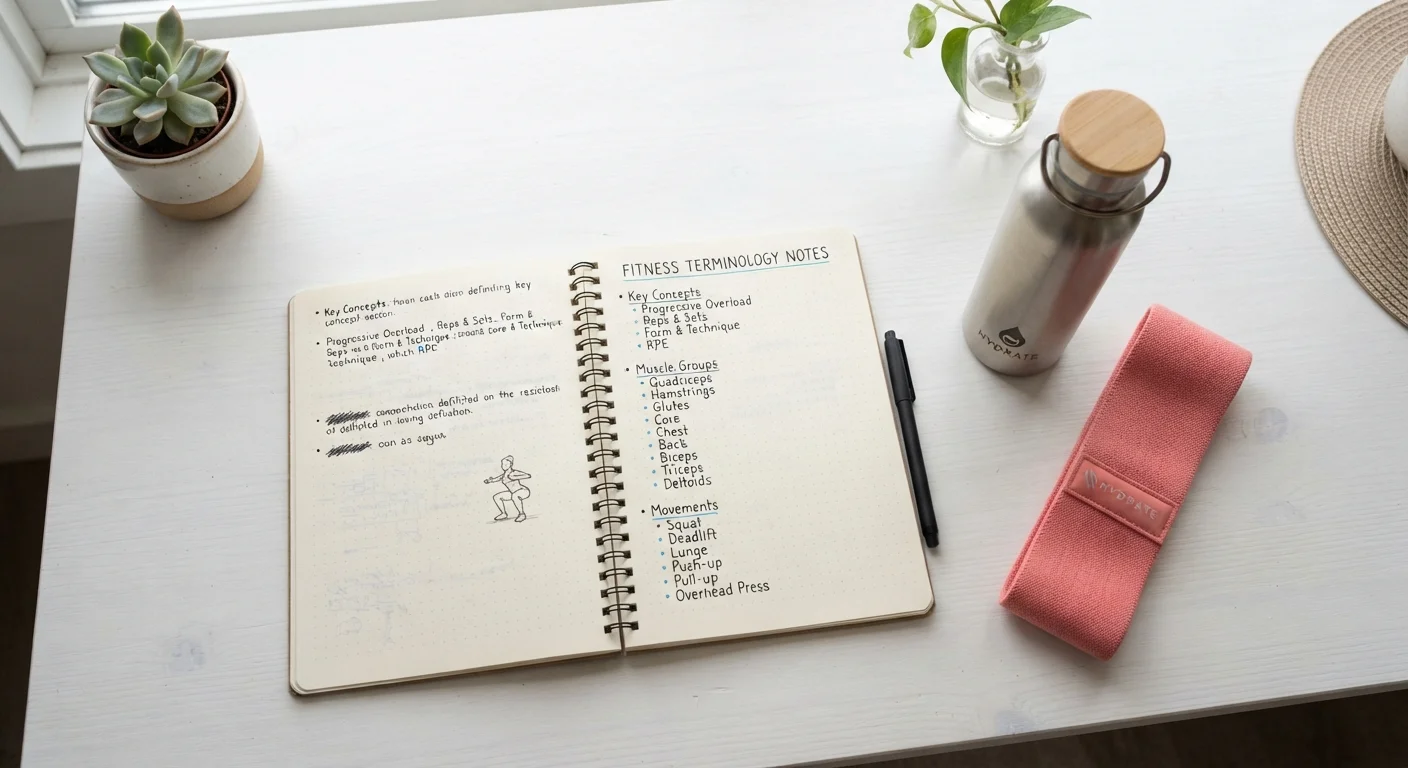
Reps, sets, RPE, VO2 max, and more: a clear reference for the fitness vocabulary beginners encounter most often.
Why fitness vocabulary matters
Walk into any gym or open a workout app and you will likely see words like superset, RPE, or VO2 max used without explanation. That gap between jargon and meaning can make fitness feel like an insider club you have not been invited to join.
This reference guide defines the terms you will encounter most often, in plain language. It is not medical advice, and it is not a training program. Think of it as a vocabulary card you can return to whenever a new term stops you. If you are weighing whether to start a routine, a practical self-check can help you assess readiness first.
Core training terms
Rep (repetition)
One complete execution of an exercise movement, such as one squat or one push-up.
Set
A group of consecutive reps performed before resting. "3 sets of 10" means 10 reps done three times with rest in between.
Progressive overload
The practice of gradually increasing training demands (weight, reps, or density) so the body continues to adapt over time.
RPE
Rate of Perceived Exertion. A self-rated scale (usually 1 to 10) describing how hard an effort feels during exercise.
VO2 max
The maximum volume of oxygen the body can use during intense aerobic exercise. It is a common measure of cardiovascular fitness.
HIIT
High-Intensity Interval Training. A format that alternates short bursts of hard effort with rest or low-intensity recovery periods.
Compound exercise
A movement that involves multiple joints working together, such as a squat, deadlift, or bench press.
Isolation exercise
A movement that focuses on a single joint or muscle group, such as a bicep curl or leg extension.
These eight concepts appear in almost every program, regardless of whether you train at home, outdoors, or in a gym. Understanding them helps you read a workout description accurately rather than guessing.
Rep and set are the two most foundational units. A rep (repetition) is one complete movement, such as one squat or one push-up. A set is a group of reps performed back to back before you rest. When a program says "3 sets of 10," it means you do 10 reps, rest, and repeat that sequence two more times.
Rest interval is the time you pause between sets. Shorter rest (around 30 to 60 seconds) tends to challenge muscular endurance. Longer rest (2 to 3 minutes) is common when lifting heavy loads and allowing fuller recovery between efforts.
Compound vs. isolation exercises describes how many joints a movement involves. A squat or deadlift is compound because multiple joints (hip, knee, ankle) move together. A bicep curl is isolation because it focuses on a single joint. Most well-rounded programs include both.
Progressive overload is the gradual increase of stress placed on the body over time, whether through more weight, more reps, or less rest. Without some form of progression, the body adapts and improvement slows. This does not mean adding weight every single session; small, consistent increases over weeks are more sustainable.
Once you have a baseline, methods that go beyond the scale can help you see whether your effort is translating into real change.
Intensity and cardio metrics
RPE (Rate of Perceived Exertion) is a self-reported scale, typically 1 to 10, that describes how hard an effort feels. An RPE of 6 might feel like a brisk walk where you can hold a conversation. An RPE of 9 is near-maximal effort where speaking more than a few words is difficult. Many programs use RPE because it accounts for daily variation in energy levels better than a fixed number alone.
VO2 max is a measure of the maximum amount of oxygen your body can use during intense exercise. It is often cited as a marker of cardiovascular fitness. Higher values generally reflect better aerobic capacity, though genetics, age, and training history all influence it. Most people do not need to measure it precisely; it is useful context when reading about cardio performance.
HIIT (High-Intensity Interval Training) alternates short bursts of hard effort with recovery periods. A 20-second sprint followed by 40 seconds of walking is one interval. HIIT is popular because sessions can be shorter than steady-state cardio while still challenging the cardiovascular system. It is not suited for every fitness level, and a healthcare professional should be consulted before starting if you have any cardiovascular concerns.
This article is for informational purposes only and is not medical advice. Consult a qualified healthcare professional before beginning any new exercise program, especially if you have an existing health condition.
The content on this site is for informational purposes only and is not a substitute for professional advice. Always consult a qualified professional for guidance specific to your situation.