
Free Weights vs. Resistance Bands for Building Strength at Home

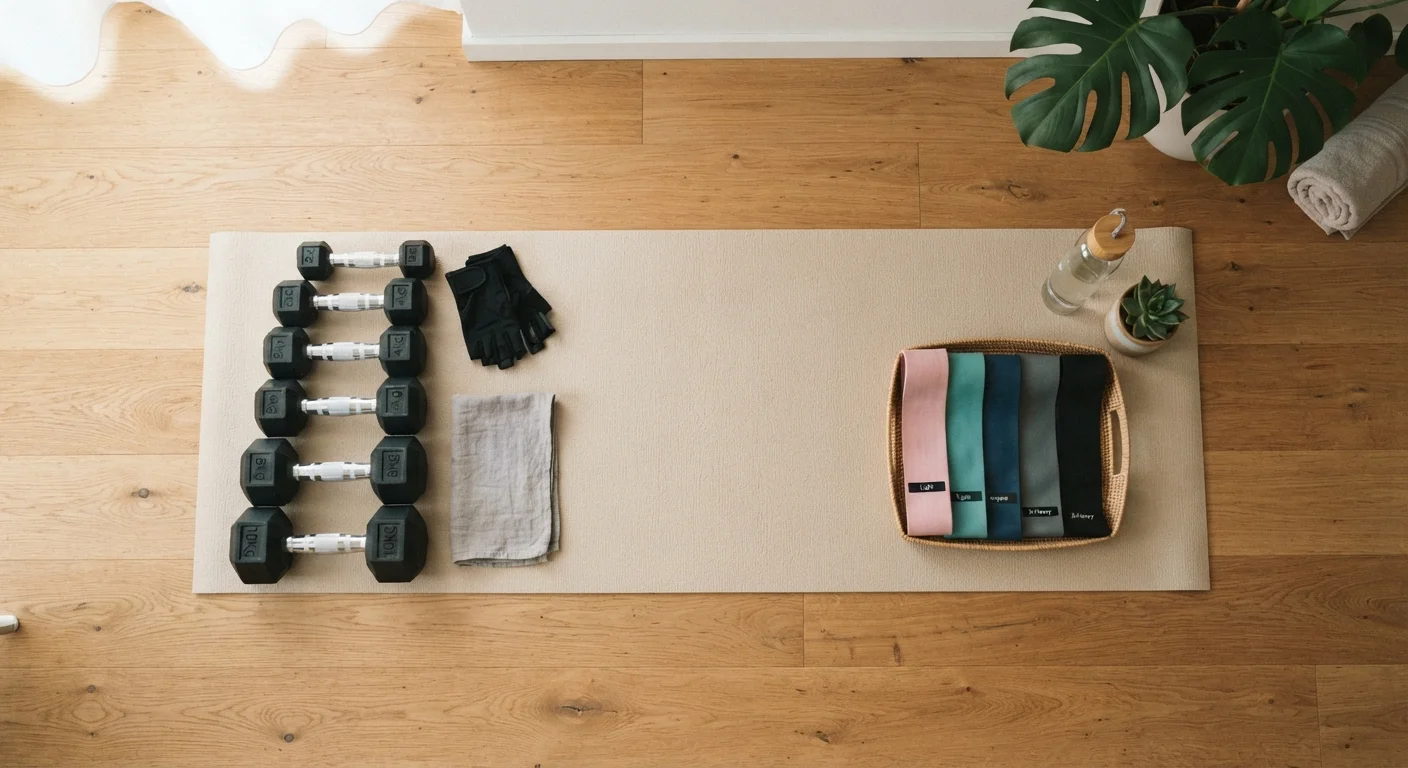
Both tools can build strength effectively. Compare how free weights and resistance bands differ in feel, cost, and training versatility.
Option A
Free weights
The familiar, load-progressive choice for home training.
Best for: Anyone who wants a fixed, measurable load and plans to increase weight over time.
Option B
Resistance bands
The portable, joint-friendly option that travels anywhere.
Best for: Anyone looking for a low-cost, space-saving way to train at home or on the road.
Key takeaways
- Both free weights and resistance bands can produce meaningful strength gains when used consistently.
- Free weights offer a fixed, easy-to-track load; resistance bands provide variable tension that increases as the band stretches.
- Resistance bands cost less and take up far less space, making them practical for small homes or travel.
- Free weights carry a higher injury risk if form breaks down, especially under heavy loads.
- Many people find combining both tools gives them more exercise variety than either alone.
- If you have an existing injury or joint concern, check with a healthcare professional before starting any new strength program.
How each tool creates resistance
Free weights use gravity. A dumbbell or barbell has a fixed mass, so the force you work against stays consistent throughout a movement. That consistency is part of why free weights are easy to program: if you lifted 20 pounds last week and lift 25 this week, the progression is clear.
Resistance bands work differently. Their tension comes from the elastic material stretching, which means resistance increases as the band lengthens. At the start of a bicep curl with a band, the pull is lighter; near the top of the movement, it is heavier. This variable resistance curve is not better or worse than constant load, but it does feel different and affects which part of a movement gets the most challenge.
| Criterion | Free weights | Resistance bands |
|---|---|---|
| Cost to start | Moderate to high | Low |
| Storage space needed | Significant | Minimal |
| Load tracking | Exact, fixed increments | Approximate, varies by stretch |
| Resistance curve | Constant through movement | Increases as band stretches |
| Joint compression | Higher under heavy load | Lower for most movements |
| Exercise variety | Very wide | Wide, with some limits |
| Portability | Low | High |
Neither resistance profile is universally superior. Research, including work published in the Journal of Human Kinetics, has found that bands and free weights can produce similar levels of muscle activation in many exercises. The tool that gets used consistently is the one that matters most.
Practical realities: cost, space, and safety
For most home setups, the practical differences between the two tools matter as much as the training science. A starter set of resistance bands typically costs well under $30 and fits in a small bag. A set of dumbbells covering a useful range of weights can cost significantly more and requires a rack or floor space to store safely.
Bands wear out over time
Resistance bands degrade with regular use, especially when exposed to sunlight or stored kinked. Inspect bands before each session for small tears or discoloration near the ends. A snapped band can cause a minor injury, so replacing worn bands promptly is a straightforward precaution.
On the safety side, free weights demand more attention to form, particularly under heavier loads. A dumbbell dropped on a foot or a barbell lifted with a rounded back can cause real injury. Resistance bands carry their own risks, mainly snapping if worn or overstretched, but the consequences of a technique breakdown are generally less severe. That said, poor movement patterns can cause injury with any tool, so learning proper form matters regardless of what you pick up.
Which situations suit each tool
Free weights tend to work well when progressive overload is a priority. If your goal is to systematically get stronger over months, being able to add five pounds at a time to a lift is genuinely useful. Dumbbells also support a wide range of compound movements (squats, presses, rows, lunges) that engage multiple muscle groups at once.
Resistance bands are a practical fit for small apartments, travel, or anyone who wants to exercise without dedicated equipment storage. They also work well as a complement to free weights: bands add variety to warm-ups and are commonly used in physical rehabilitation settings, where reducing joint load during recovery is useful. If you are managing an injury or a chronic condition, talk with your doctor or physical therapist before starting or changing a strength routine.
A combined approach is common and reasonable. Many people keep a modest set of dumbbells and a few bands, using each where it suits the exercise rather than treating the choice as permanent.
This article is general health and fitness information only, not medical advice. Consult a qualified healthcare professional before beginning a new exercise program, especially if you have an existing injury, medical condition, or are in a special population such as pregnancy or older adulthood.
The content on this site is for informational purposes only and is not a substitute for professional advice. Always consult a qualified professional for guidance specific to your situation.