
Shares vs Funds: Choosing a Starting Point That Matches Your Situation

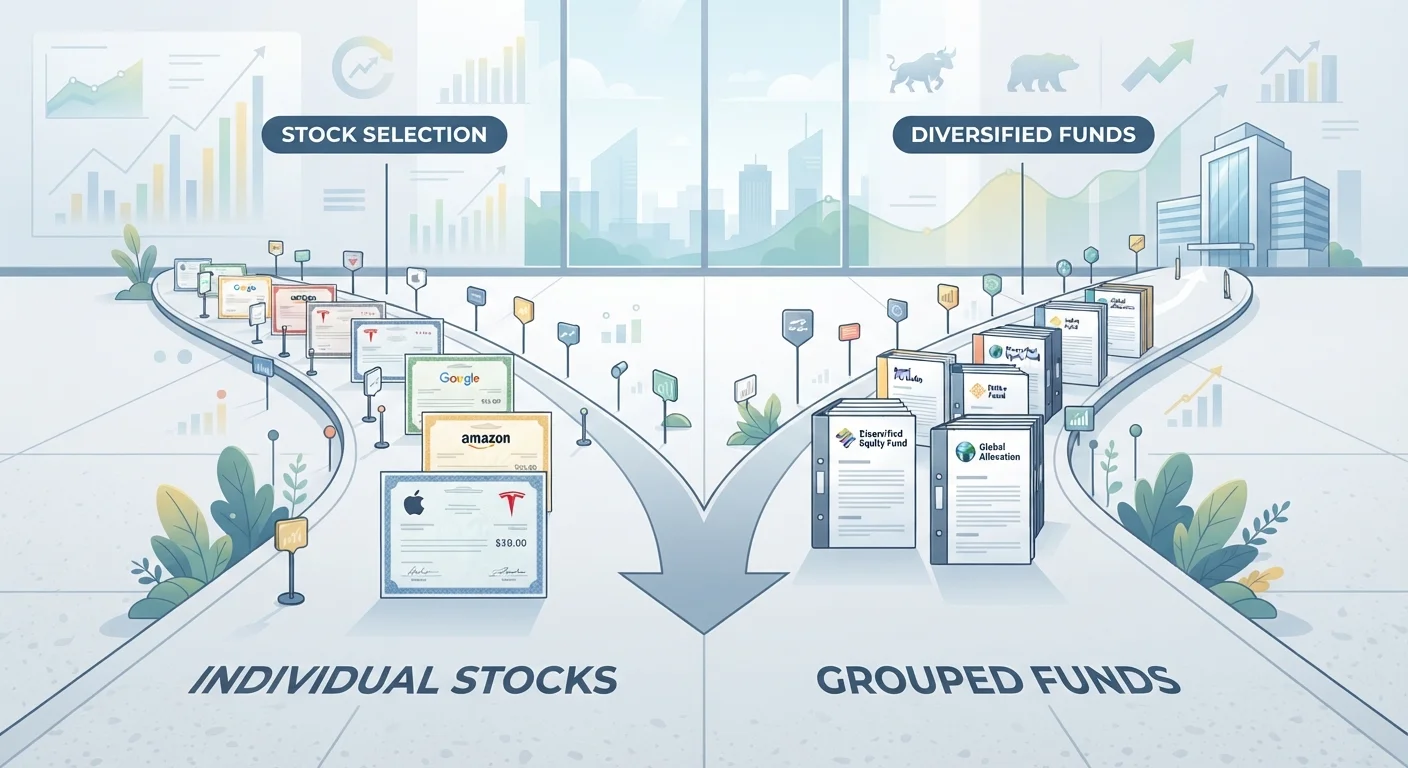
A side-by-side look at buying individual company shares versus pooled funds, covering effort, diversification, and what each approach demands.
Our Verdict
For most people starting out, funds offer a more practical entry point because they spread risk without requiring constant research. Individual shares suit those who have the time and interest to study specific companies and can handle seeing larger swings in their portfolio value. Both approaches can coexist once you have a foundation.
| Best for | Recommended |
|---|---|
| Those with limited time or investing experience | Funds |
| Those who want to follow specific companies closely | Individual shares |
| Those prioritizing built-in diversification from day one | Funds |
| Those comfortable with higher volatility for potential higher reward | Individual shares |
Key takeaways
- Individual shares give you direct ownership of a company but concentrate your risk in fewer positions.
- Funds spread money across many holdings automatically, which reduces the impact of any single investment failing.
- Stock-picking demands more research, time, and tolerance for volatility than most beginners expect.
- Fees differ between fund types, and small percentage differences compound meaningfully over time.
- Neither approach is universally better. Your time, knowledge, and risk comfort shape which fits.
What you actually own with each approach
When you buy an individual share, you own a small slice of one company. If that company does well, your share price generally rises. If it struggles, your holding falls in value. The outcome tracks one business closely.
A fund pools money from many investors and spreads it across dozens or hundreds of securities. You own a portion of that pool rather than any single company directly. The fund manager (or an index algorithm, in the case of passive funds) decides which holdings to include and in what proportions.
This structural difference matters from the start. With shares, concentration is the default. With funds, diversification is built in. If you want a broader foundation for understanding how markets work before choosing, the complete beginner's guide to investing covers the core concepts.
Effort and knowledge required
Buying shares in individual companies takes real research. Reading company financial reports, tracking industry trends, and assessing management quality are all part of doing it responsibly. That is not a reason to avoid it, but it is a genuine time commitment.
Funds shift much of that work off your plate. An index fund, for example, simply tracks a market index like the S&P 500. You do not need to decide which 500 companies to hold or when to swap them. That decisions is governed by the index rules.
Actively managed funds sit between the two. A professional manager makes the stock-picking choices, but you still need to evaluate whether the manager's track record and strategy are worth the fees charged. Speaking of which, fees are worth understanding before you commit to any fund type. Understanding how investment fees compound helps put those numbers in practical context.
| Individual shares | Index funds | Actively managed funds | |
|---|---|---|---|
| Diversification | Low (concentrated) | High (broad market) | Medium to high |
| Research required | High | Low | Moderate (evaluating managers) |
| Ongoing fees | None (trading costs only) | Very low (often below 0.10%) | Higher (0.50% to 1.00%+) |
| Control over holdings | Full control | Index rules decide | Manager decides |
| Volatility exposure | High (company-specific) | Market-level | Market-level, varies by strategy |
| Best suited for | Research-focused investors | Most beginners | Those willing to pay for active management |
Risk and diversification
Holding five individual shares means one bad earnings report can drop your portfolio by 20%. Holding a fund that tracks 500 companies means one company's collapse barely registers at the portfolio level.
This does not mean funds are risk-free. A broad market fund still falls when markets fall broadly. The difference is that company-specific risk (one product failing, one scandal, one poor quarter) is largely absorbed by the size of the pool.
Beginners often underestimate how uncomfortable a 30% or 40% drop in a single share feels compared to a 15% broad market decline. Both are paper losses until you sell, but the emotional weight of concentration can push people to sell at the wrong moment.
Paper losses become real only when you sell
A drop in portfolio value is not a realized loss unless you sell the position. Staying invested through a market decline is historically how long-term investors recover losses and grow wealth. Selling during a downturn locks in the loss permanently. If the volatility of individual shares makes you want to sell at the wrong time, that is useful information about which approach fits your temperament.
Cost considerations
Individual shares typically carry a trading commission each time you buy or sell, though many brokerages have reduced or removed these fees. There are no ongoing management charges because there is no manager.
Funds charge an annual expense ratio. For passive index funds, this often runs below 0.10% per year in the US. Actively managed funds typically charge between 0.50% and 1.00% or more. Over decades, even a 0.50 percentage point difference in annual fees removes a meaningful chunk of compounded growth.
How often you plan to contribute also matters. If you intend to invest small amounts regularly, a fund that accepts fractional contributions is more practical than buying whole shares of high-priced companies. The mechanics of lump sum versus regular contributions affect which structure works better in practice.
A realistic starting point
Most financial education points beginners toward low-cost index funds as a starting position, not because individual shares are wrong, but because funds reduce the number of decisions you need to make correctly from the outset. As your knowledge and portfolio grow, you can layer in individual positions if that fits your goals.
Once you have a portfolio in place, you will eventually face the question of whether to adjust its proportions over time. Portfolio rebalancing explains when and why that becomes relevant.
This article is for general informational purposes only and does not constitute personalized financial, investment, tax, or legal advice. Investing involves risk, including the possible loss of principal. Past performance does not guarantee future results. Please consult a qualified financial adviser before making investment decisions based on your individual circumstances.
The content on this site is for informational purposes only and is not a substitute for professional advice. Always consult a qualified professional for guidance specific to your situation.