
Forums, Discord Servers, and Social Groups: Choosing the Right Platform for Your Interests

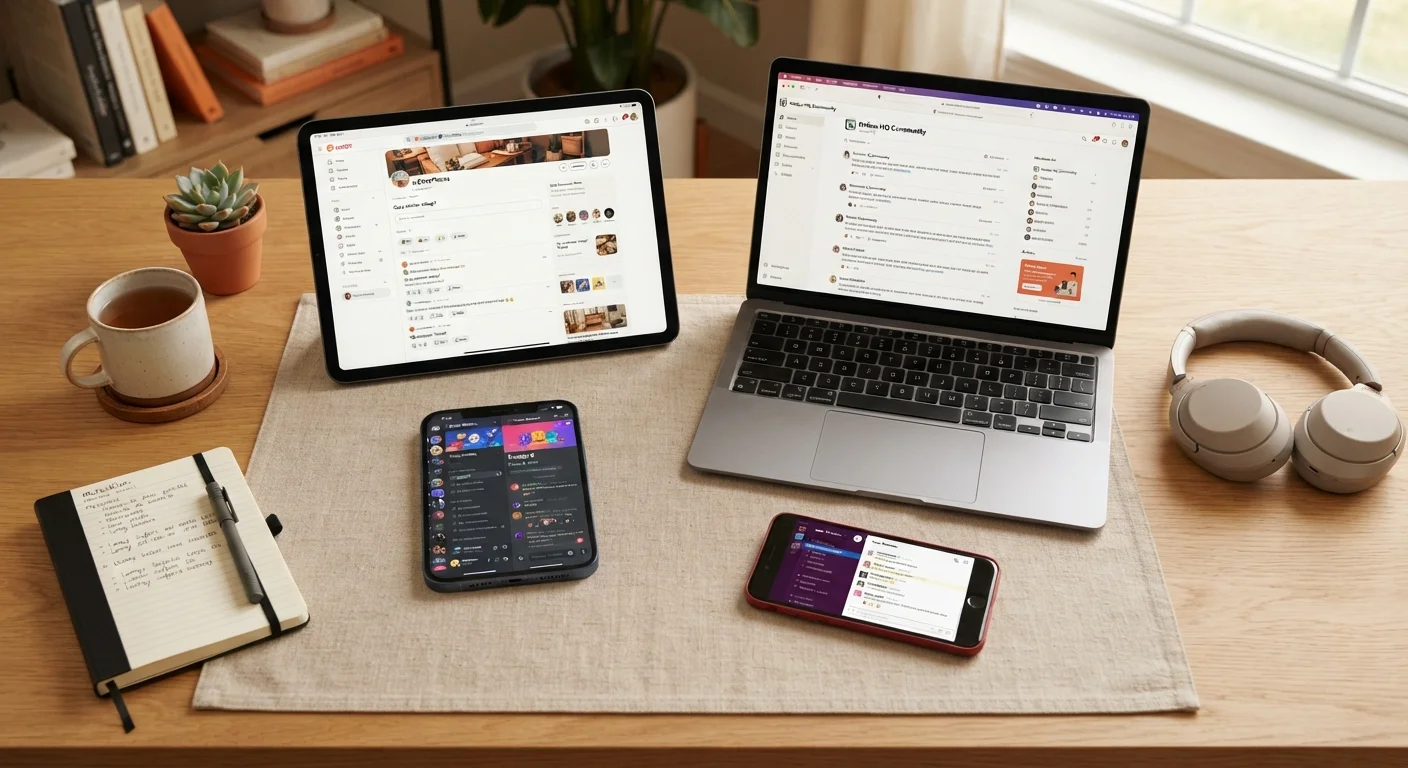
Different platforms suit different people. Compare forums, Discord, Reddit, Facebook Groups, and niche platforms to find your best fit.
Our Verdict
No single platform is objectively better. The right choice depends on how much time you have, how quickly you want responses, and whether you want a broad audience or a tight-knit group. Most people find they use two platforms in parallel: one for slow, searchable discussion and one for live interaction.
| Best for | Recommended |
|---|---|
| People who want in-depth, searchable conversations at their own pace | Traditional forums |
| Those who want live chat and voice interaction around a shared hobby or game | Discord |
| Adults seeking local or life-stage communities with a familiar interface | Facebook Groups |
| People who want broad topic discovery and anonymous participation |
Why platform choice shapes your experience
Picking a community platform is not just a technical decision. The format determines who shows up, how conversations develop, and whether you feel like a participant or a spectator. A slow forum thread and a fast Discord channel can both be about the same hobby, yet produce entirely different social experiences.
The gap between lurking and belonging often comes down to fit: does the platform's pace match your schedule? Does its culture welcome newcomers? How conversation pace affects belonging is worth understanding before you commit time to any one space.
Traditional forums
Forums such as phpBB communities, Discourse-based boards, and hobby-specific sites organize conversations into threads that persist for years. A question posted today can surface in a search three years from now, which means the collective knowledge compounds over time.
The trade-off is speed. Replies arrive in hours or days, not seconds. For some people that rhythm feels natural; for others it feels disconnected. Forums tend to attract members who write in paragraphs rather than sentences, so the culture rewards reading carefully before posting.
Moderation quality varies widely. Established forums with active moderators often feel safer and more civil than newer spaces without clear rules.
| Forums | Discord | Facebook Groups | ||
|---|---|---|---|---|
| Conversation pace | Slow, async | Fast, real-time | Mixed | Mixed |
| Content searchability | High | Low | High | Low |
| Anonymity | Varies | Pseudonymous | Pseudonymous | Usually real name |
| Best for | Deep topic discussion | Live interaction | Topic discovery | Local or life-stage groups |
| Learning curve | Low | Moderate | Moderate | Low |
| Moderation quality | Varies widely | Varies widely | Varies widely | Varies widely |
Discord
Discord organizes communities into servers with multiple text and voice channels. A single server can have channels for announcements, casual chat, topic-specific discussion, and live audio, all in one place. That structure works well when a community has several related interests or runs regular events.
The real-time nature is both the appeal and the limitation. Conversations move fast and older messages are hard to find later. If you miss a few days, catching up can feel impossible. Discord suits people who have consistent availability and want to feel present in a community, not just informed by it.
Many Discord servers also use bots to automate roles, welcome messages, and moderation, which lowers the workload on volunteer staff but can make large servers feel impersonal at first.
Reddit and Facebook Groups
Reddit sits between a forum and a social feed. Subreddits cover almost every conceivable topic, and the upvote system surfaces popular content quickly. Anonymous or pseudonymous participation lowers the barrier to posting, but that same anonymity can make the culture harsh in some communities. Finding subreddits with thoughtful moderation takes some trial and error.
Facebook Groups reach a different demographic. Many adults who are not active on Discord or Reddit do participate in Facebook Groups, particularly around local interests, parenting, health conditions, and professional fields. The interface is familiar to people who already use Facebook, which removes one learning curve. The downside is that content is tied to a platform with a commercial algorithm, so what you see is filtered in ways you cannot fully control.
A fuller guide to participating in online communities as an adult covers how to navigate these dynamics across platforms.
Niche and specialized platforms
Some communities exist on platforms built specifically for their purpose: Letterboxd for film discussion, Goodreads for readers, Strava for runners, or specialized forums for crafts, mental health support, or professional fields. These platforms often produce stronger belonging because every member already shares a core interest before the first message is sent.
The limitation is reach. A niche platform may have far fewer members than a Reddit community on the same topic, which means slower conversations and less variety of opinion. Whether that trade-off works depends on whether you want breadth or depth.
Before settling on any platform, it is worth spending a week reading without posting. How members treat newcomers, how disputes get resolved, and whether the conversation feels genuine are all visible before you introduce yourself. Setting up a profile that invites genuine connection can help once you have found the right space.
Try before you commit
Spend at least a few days reading a community before you post. Notice whether members help newcomers or ignore them, whether the rules are enforced consistently, and whether the conversation depth matches what you are looking for. Joining several spaces at once often leads to abandoning all of them; picking one and giving it genuine time produces better results.
The content on this site is for informational purposes only and is not a substitute for professional advice. Always consult a qualified professional for guidance specific to your situation.