
The Psychology of Group Identity in Online Spaces

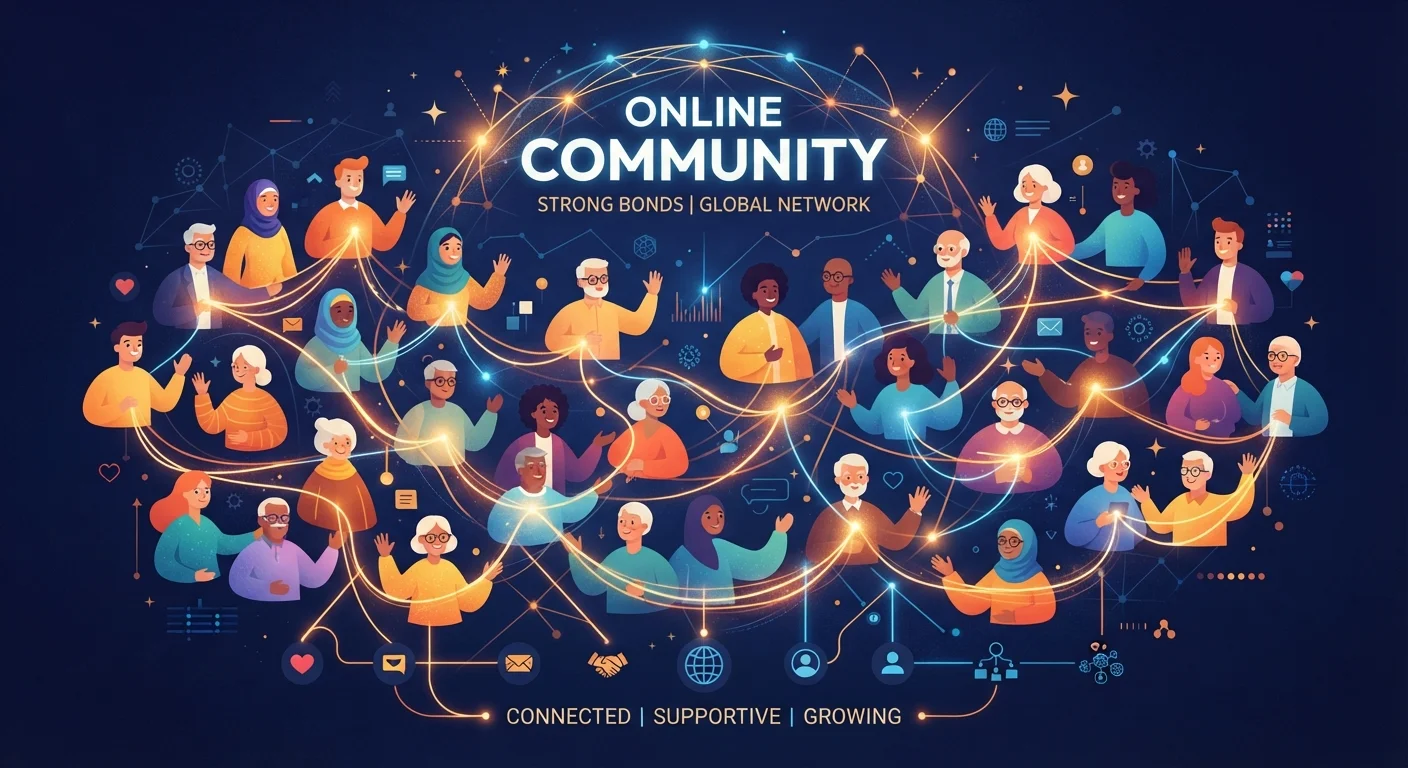
Why do people feel so strongly about their online communities? Explore the social psychology behind in-group loyalty, belonging, and tribal behaviour online.
Key takeaways
- The human brain processes online group membership using the same social circuits as in-person belonging.
- Shared language, rituals, and norms are what separate a random collection of users from a genuine community.
- In-group loyalty can produce real support and connection, but it also creates pressure to conform and exclude others.
- Understanding these dynamics helps you choose communities that strengthen rather than limit your sense of self.
- Passive membership rarely generates belonging; participation is what activates the identity bond.
Why the brain treats 'us' and 'them' the same way online
The brain does not have a separate circuit for digital relationships. When you receive a reply from a forum regular who has followed your posts for months, the social warmth you feel is processed by the same neural regions involved in face-to-face recognition. This is why group identity in online spaces can feel surprisingly intense, even when you have never heard anyone's voice.
Henri Tajfel and John Turner's social identity theory, developed through experiments in the 1970s, showed that people need only the thinnest category to start favouring an in-group. Participants divided arbitrarily by coin flip began to allocate more resources to their own side. Online, the categories are rarely arbitrary: they are built around shared passions, identities, or experiences, which makes the group bond considerably stronger.
What this means practically is that when you join a community around a chronic illness, a niche hobby, or a life transition, you are not just accessing information. You are potentially adding a layer to your self-concept. The question worth asking is whether that layer expands who you are or quietly narrows it.
This is not the same as addiction
Feeling a strong pull toward an online community is not automatically a warning sign. Humans are social animals, and group membership meets a genuine psychological need. The concern worth watching is whether a community's demands on your time and loyalty are proportionate to what it gives back, not whether the attachment feels real.
How online communities build a shared identity
A random collection of users becomes a community through accumulated shared meaning. Inside jokes, recurring phrases, community-specific vocabulary, and unwritten rules all create what sociologists call a 'symbolic boundary': a line that separates members from non-members. When you recognise that vocabulary and use it naturally, you signal membership to everyone else in the space.
Rituals matter too. Weekly threads, initiation customs (the expectation that new members introduce themselves), and community-wide reactions to outside events all give members a shared timeline and a sense of collective experience. These are not trivial social niceties. They are the mechanics through which identity forms.
Participating actively in online communities accelerates this process. Lurking, by contrast, keeps you on the outside of the identity bond even when you consume the content regularly. If belonging is what you are after, contribution is the faster route. For more on that dynamic, see our piece on lurking versus participating in online spaces.
The costs of strong group identity
Strong in-group bonds produce real benefits: social support, reduced loneliness, a stable sense of belonging. The same psychological forces also produce costs that are worth understanding before you invest heavily in any single community.
The first cost is conformity pressure. Groups enforce norms, and members who deviate face social penalties ranging from gentle correction to expulsion. In a healthy community, this keeps interactions respectful. In a less healthy one, it suppresses honest disagreement and creates an illusion of consensus that does not reflect what members privately think.
The second cost is out-group hostility. Once a group identity is active, the brain tends to view outsiders with more skepticism than the evidence warrants. Online, where moderation is inconsistent and anonymity is common, this can produce coordinated hostility toward people who criticise the group or simply represent a rival community.
The third cost is identity foreclosure: when group membership becomes so central to self-concept that leaving feels like a personal threat. People in this position may stay in communities that no longer serve them, defending the group against criticism they privately agree with.
Check your community's tolerance for disagreement
Before investing deeply in any online group, post a polite, reasoned opinion that differs from the majority view and observe the response. Communities that handle internal disagreement well tend to be more psychologically safe over the long term. Spaces that respond to mild dissent with mockery or pile-ons signal that belonging there will come with conformity costs.
Choosing communities that work for you
Understanding group identity psychology gives you a useful filter when evaluating where to spend your time online. A community worth joining has norms that protect disagreement, not just cohesion. Members can question the group's assumptions without social penalty. New people are welcomed rather than tested. If those conditions are absent, the belonging on offer tends to come with a cost to your independent thinking.
It also helps to hold membership lightly. You can care about a community and contribute genuinely without making it the primary source of your self-worth. People who belong to several communities with different values and norms are generally more resilient when any one of those communities disappoints them.
For practical guidance on finding spaces worth your time, see how to find online communities worth joining. If geography or circumstance limits your access to in-person connection, our piece on digital belonging and geography covers how online communities can fill that gap without replacing the full range of social connection you need.
Frequently Asked Questions
The content on this site is for informational purposes only and is not a substitute for professional advice. Always consult a qualified professional for guidance specific to your situation.