
What the Sticker Price on a Car Window Actually Tells You

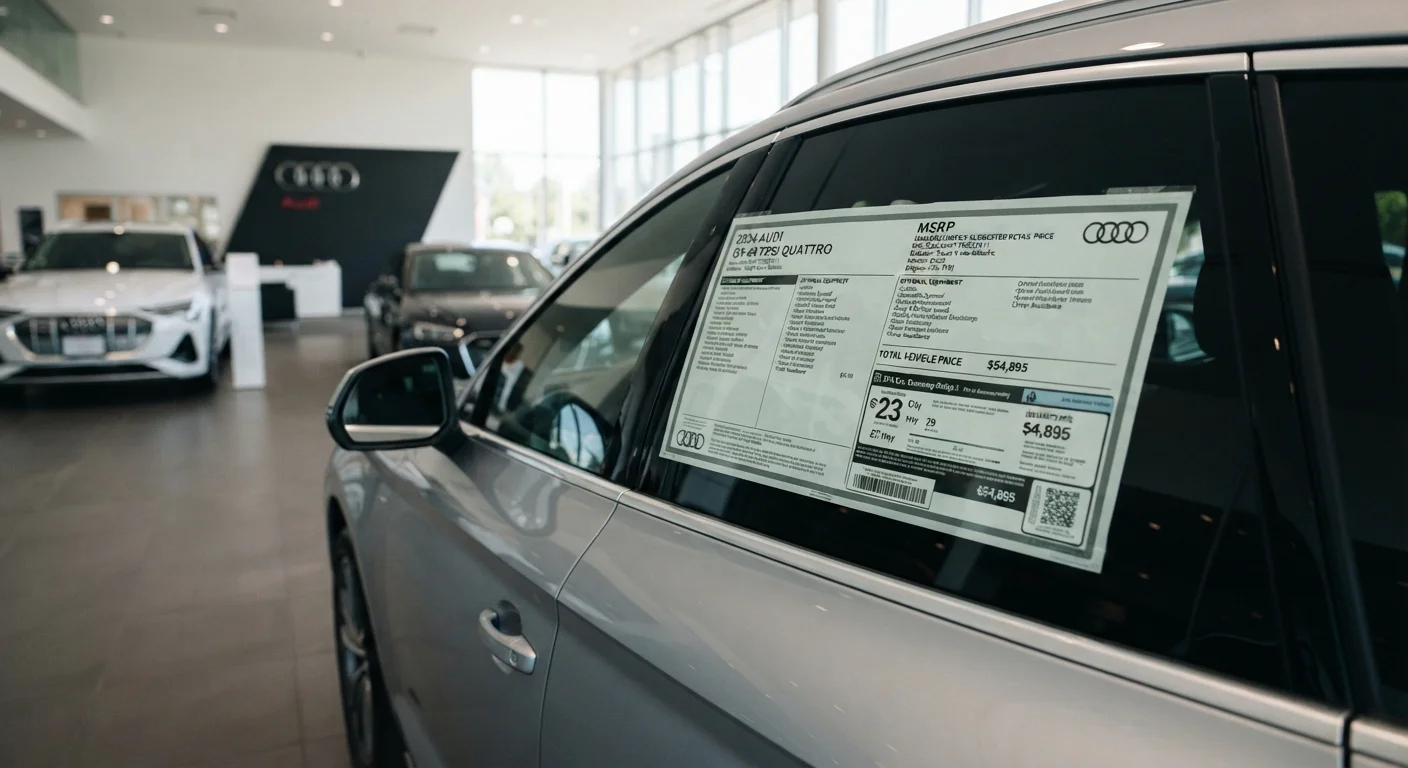
Decode the Monroney label and understand invoice price, dealer markup, and fees before you walk into any showroom.
Key takeaways
- MSRP is the manufacturer's suggested retail price, not a binding sale price.
- The sticker separates base price from option packages and destination charges.
- Invoice price is what the dealer paid, but it is not the dealer's true cost after holdbacks and incentives.
- Dealer markups above MSRP are legal and appear as addendum stickers.
- Understanding the sticker before you negotiate puts you in a stronger position.
What the Monroney label actually contains
Every new car sold in the United States carries a window sticker that follows a federally standardized format. Reading it section by section gives you the clearest picture of what you are paying for before anyone quotes you a number out loud.
The sticker opens with the base price, the cost of the vehicle in its lowest trim configuration with no added options. Below that, each factory-installed option or package is listed individually with its own price. Adding the base price and all option prices gives you a subtotal called the adjusted vehicle price.
Below the adjusted vehicle price sits the destination and delivery charge, a fixed fee the manufacturer sets to cover shipping from the assembly plant to the dealership. This charge is the same at every dealer in the country for a given model, so it is not a number you can negotiate away.
The final line is the MSRP, the sum of everything above. The sticker also includes fuel economy estimates from the EPA and, on most vehicles, a comparison of those figures against other cars in the same class.
What the sticker does not tell you
The Monroney label covers only what the manufacturer charges. It says nothing about what the dealer will actually accept, and it leaves out several cost categories that show up later in your purchase contract.
Taxes, title fees, and registration are set by your state and county, not the manufacturer. A documentation fee, which dealers charge for processing paperwork, also appears separately. Those line items can add a meaningful amount to your total. For a detailed breakdown, see the full guide to fees on a car purchase contract.
The sticker also does not show the invoice price, which is what the dealer paid the manufacturer. That figure is often available through third-party research tools and can serve as a useful reference point. Be aware, though, that dealers frequently receive manufacturer holdback payments after the sale, so invoice is not a precise measure of their actual cost.
If a vehicle is in short supply, dealers sometimes attach a second label called an addendum sticker. This can list a market adjustment, meaning an amount above MSRP that the dealer wants to charge given demand. Addendum charges are legal and negotiable. Treat them as a starting position, not a fixed requirement.
Build your reference price before visiting
Use the manufacturer's official build-and-price tool to configure the exact trim and options you want. Print or save that summary and compare it line by line against the sticker on the car at the dealership. Discrepancies are worth asking about before the negotiation begins.
How to use the sticker before you negotiate
Walk in knowing the full MSRP of the specific trim and option combination you want. Use the manufacturer's website to build that configuration at home; the resulting price summary will mirror the sticker closely. When you arrive at the dealership, the sticker on the actual car gives you a way to verify that the vehicle matches what you researched.
From there, the conversation should be about the out-of-door price, the total amount you will pay including all fees, taxes, and charges. Focusing on that single number is more reliable than negotiating only the vehicle price and discovering fees later. Negotiating around a monthly payment instead can obscure the true total, particularly if the loan term is extended.
Before signing anything, review every line on the purchase agreement against what the sticker showed and what you discussed. The questions worth asking before you sign can help you catch discrepancies before they become your problem.
The sticker is not a ceiling and it is not a floor. It is a published baseline, and knowing how to read it is the first step toward a transaction you understand completely.
Frequently Asked Questions
The content on this site is for informational purposes only and is not a substitute for professional advice. Always consult a qualified professional for guidance specific to your situation.