
Questions Worth Asking Before Signing a Car Purchase Agreement

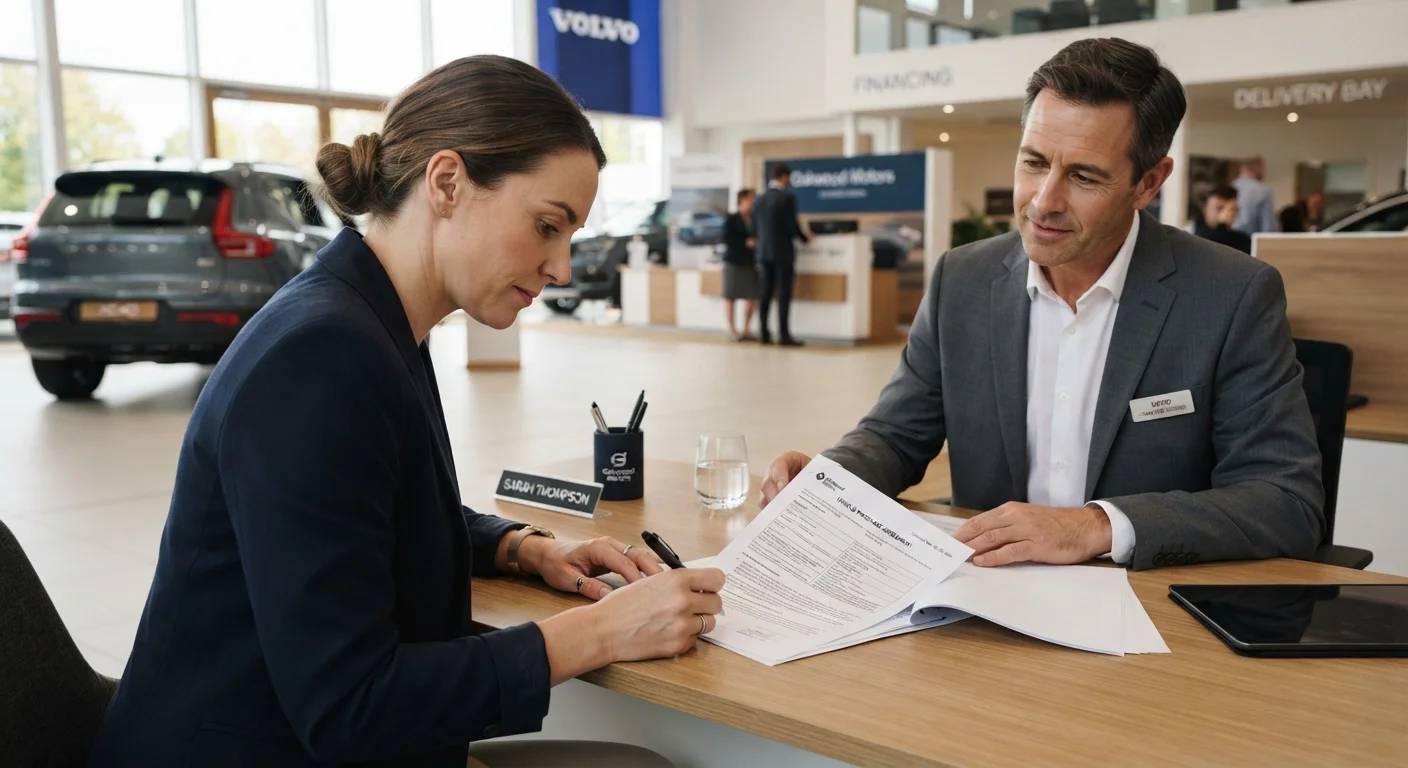
A practical checklist of questions about price, fees, warranty, and financing that help you avoid surprises at the point of signing.
Summary
22 items · 20 to 40 minutes at the dealership
Key takeaways
- Every fee on the purchase agreement should have a clear, written explanation before you sign.
- The out-of-pocket total matters more than the monthly payment figure alone.
- Dealer financing rates can sometimes be adjusted, so compare with outside lenders first.
- Warranty terms vary widely; confirm exactly what is covered, for how long, and at which service locations.
- Any verbal promise from a salesperson has no legal weight unless it appears in writing on the contract.
Why this moment deserves more than a quick skim
The finance office is where many car buyers feel the most pressure. The deal is effectively done, paperwork is thick, and staff may act as though signing quickly is routine. That environment is exactly why a prepared list of questions changes the outcome.
A purchase agreement is a legally binding document. Anything not written in it does not exist from a contract standpoint. Dealers are generally required to disclose all fees and financing terms, but the format of that disclosure can be dense and confusing. Working through the checklist below before you put pen to paper keeps you in control of the process.
For a broader view of how this moment fits into the overall transaction, see the full car-buying walkthrough that covers every stage from budget-setting to taking delivery.
Price and fees
Financing terms
Warranty and coverage
Document verification
Tools that make review easier
You do not need special equipment to get through a purchase agreement carefully, but a few resources reduce guesswork.
Pre-approval letter from your bank or credit union
Gives you a baseline financing rate to compare against the dealer's offer.
Calculator (phone app is fine)
Lets you verify monthly payment math and calculate total loan cost on the spot.
Vehicle history report
Confirms ownership history, reported accidents, and odometer readings for used vehicles.
Photo ID and insurance card
Required to complete the purchase and register the vehicle in your name.
State DMV fee schedule (printout or bookmarked page)
Lets you verify that title and registration fees match your state's published rates.
Understanding individual line items is half the work. The guide to car purchase contract fees breaks down what documentation fees, dealer prep charges, and destination fees actually cover so you can judge whether each one is standard in your state.
Questions about price and fees
The agreed selling price should match exactly what appears on the contract. Discrepancies between a handshake number and a printed figure do sometimes appear, and they are not always in the buyer's favor.
Ask the finance manager to walk through every line item above the base price. Some fees are set by law, such as title and registration costs. Others, like documentation fees, vary by dealer and are sometimes negotiable. A few fees have no regulatory basis at all and can be declined or questioned. The fee explanation guide lists the most common ones.
Watch for fees added after negotiation
Some fees appear in the finance office that were not discussed during price negotiation. Market adjustment markups, advertising fees, and dealer prep charges are among the most commonly contested. You have the right to ask about each one and, in some cases, to decline it. If a fee cannot be explained in plain terms, ask for that explanation in writing before you proceed.
Add-on products such as paint protection, fabric sealing, and tire coverage packages often appear as line items after the base price. Each should be itemized separately, with its own cost and cancellation terms visible on the contract. If you did not request an add-on, you can ask for it to be removed before signing.
Questions about financing
If you are financing through the dealer, the contract will show the annual percentage rate (APR), loan term in months, total interest paid over the life of the loan, and the total amount financed. Each of those numbers deserves a direct question.
Dealers sometimes mark up the interest rate above what a lender actually quoted, keeping the difference as compensation. Getting a pre-approval from your own bank or credit union before visiting gives you a comparison point. For practical context on how rate negotiation works, the article on negotiating interest rates covers what borrowers can realistically request and how to approach the conversation.
Confirm whether the loan has a prepayment penalty, which is a fee charged if you pay off the balance early. Not all states permit them, but some contracts still include them. Also ask whether a co-signer is required and what happens to the loan terms if one is removed later.
Questions about warranty coverage
New vehicles come with manufacturer warranties, but the specific terms vary by component. A powertrain warranty covers the engine and transmission; a bumper-to-bumper warranty covers most other systems but still has exclusions. Ask for the warranty booklet, not a verbal summary, and confirm the mileage and time limits for each coverage tier.
If the dealer is offering an extended service contract (often called an extended warranty, though it is technically a separate product), ask who backs it: the manufacturer or a third-party administrator. Third-party contracts carry more risk if the administering company closes or disputes a claim.
For used vehicles, confirm in writing whether the car is sold as-is, which means no warranty coverage applies after the sale. A pre-purchase inspection by an independent mechanic is worth arranging before you reach the signing stage. The pre-purchase inspection guide explains what that process involves and which items a mechanic should check.
Before you walk out with the keys
Request a complete copy of every document you sign, including the purchase agreement, financing contract, and any add-on product terms. Dealers are required to provide copies, and you should read them before leaving the lot.
Verify that the vehicle identification number (VIN) on the contract matches the VIN on the physical vehicle, typically visible through the windshield at the base of the dashboard. A mismatch, however unlikely, needs to be resolved before the deal closes.
If anything in the agreement differs from what was discussed verbally, ask for it to be corrected in writing before signing. Do not accept assurances that something will be handled later. If you bought from a private seller rather than a dealership, the process has different documentation requirements, covered in the private sale car buying guide.
The content on this site is for informational purposes only and is not a substitute for professional advice. Always consult a qualified professional for guidance specific to your situation.