
Car Battery Health: Understanding Charge, Cranking Power, and Lifespan

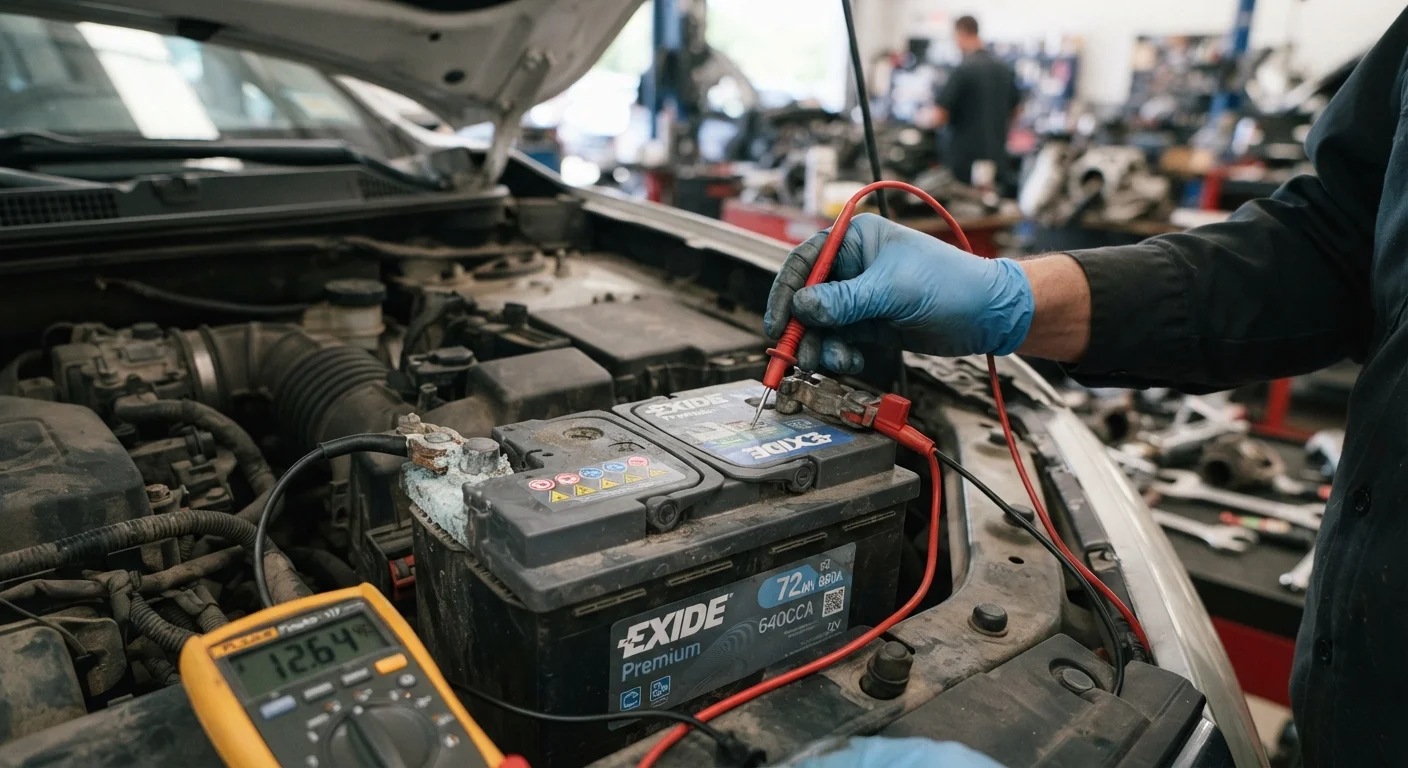
A battery does more than start your engine. This explainer covers how automotive batteries work, what drains them, and how to gauge remaining life.
Key takeaways
- Most conventional car batteries last three to five years under normal driving conditions.
- Cold weather reduces a battery's ability to deliver cranking power, even if the battery is otherwise healthy.
- Voltage alone does not tell the full story; a load test reveals actual cranking ability.
- Short trips and long periods of inactivity accelerate battery degradation.
- Corrosion on terminals is a visible, correctable factor that affects battery performance.
How a car battery actually works
A standard automotive battery is a 12-volt lead-acid unit made up of six cells, each producing about 2.1 volts. Each cell contains lead plates submerged in a diluted sulfuric acid solution called electrolyte. When you turn the ignition, a chemical reaction between the plates and electrolyte releases electrical energy. The alternator then recharges the battery while the engine runs.
The battery serves two distinct functions that drivers often conflate. First, it delivers a large burst of current to the starter motor, which turns the engine over until combustion begins. Second, it acts as a buffer, stabilizing voltage across the electrical system when demand exceeds what the alternator alone can supply. A battery that handles one function poorly may still appear to handle the other adequately, which is why testing matters more than casual observation.
For a broader look at how temperature affects this chemistry, see how heat and cold affect your battery and other systems.
Cranking power: the metric that matters most at startup
Cold cranking amps (CCA) is the rating that describes how much starting power a battery can deliver in freezing conditions. The Society of Automotive Engineers defines it as the current a battery can supply for 30 seconds at 0 degrees Fahrenheit while staying above 7.2 volts. Your vehicle's owner manual specifies the minimum CCA the battery must meet; installing a battery below that threshold increases the risk of hard starts in winter.
As a battery ages, its actual CCA falls below its rated figure even when the battery holds a surface charge and reads normal voltage. This is why a battery can show 12.6 volts on a multimeter but still fail to start the car on a cold morning. A load test, performed by most auto parts stores or mechanics at no charge, applies a controlled current draw and measures how the battery responds under stress. Voltage-only checks miss this degradation.
3 to 5 years
Typical lifespan of a conventional lead-acid car battery
This range is widely cited by automotive maintenance organizations and reflects average North American driving conditions.
~35%
Reduction in battery capacity at 0 degrees Fahrenheit
Cold temperatures significantly reduce available cranking power, which is why CCA ratings are measured at 0 degrees Fahrenheit.
50 mA or less
Normal parasitic draw for most modern vehicles
A draw consistently above this range can indicate a faulty module or wiring issue that will drain a battery within days.
What drains and degrades a battery over time
Three patterns accelerate battery wear beyond normal aging. The first is chronic undercharging. Short trips, typically under 15 to 20 minutes, do not give the alternator enough time to fully replenish what the starter used. Repeated partial discharge cycles allow sulfate crystals to form on the lead plates, a process called sulfation, which reduces the battery's capacity permanently.
The second pattern is parasitic drain. Every vehicle draws a small standby current to maintain clocks, alarm systems, and control module memory. If a vehicle sits unused for several weeks, this slow drain can discharge the battery enough to damage it. A parasitic draw that exceeds normal levels, sometimes caused by a faulty module or wiring issue, can kill a battery in days.
The third factor is heat. While cold weather is the most visible stressor at startup, sustained high temperatures cause electrolyte to evaporate and accelerate plate corrosion inside the battery. Vehicles parked frequently in direct sun, or driven in hot climates, often see shorter battery life than the three-to-five-year average. Keeping a service log that includes battery test dates helps you track the timeline and catch early warning signs.
How to gauge remaining battery life
A multimeter set to DC voltage gives a quick snapshot of charge state. Measure with the engine off and all accessories shut down, ideally after the car has sat for several hours. A reading of 12.6 volts or higher indicates a full charge. Between 12.4 and 12.6 volts suggests a partial charge that may indicate the battery is not accepting a full charge. Below 12.0 volts points to a significantly discharged or degraded battery.
For a complete picture, a conductance tester or carbon-pile load tester measures the battery's internal resistance and its ability to deliver power under load. These tests are more reliable than voltage alone because they reveal how much usable capacity remains, not just whether the battery currently holds a charge. Many auto parts retailers offer battery testing as a free walk-in service.
Visual inspection also matters. White or blue-gray powder around the terminals is corrosion that increases electrical resistance. Cleaning terminals with a baking-soda-and-water solution and a wire brush, after disconnecting the cables safely, can restore a clean connection. If the battery case is bulging or cracked, the battery should be replaced immediately and handled carefully due to acid exposure risk. A mechanic should assess any case where physical damage is present.
Worn starting components can mimic battery symptoms. Spark plug condition also affects starting reliability, so ruling out ignition system issues alongside battery testing gives a more complete diagnosis.
Frequently Asked Questions
The content on this site is for informational purposes only and is not a substitute for professional advice. Always consult a qualified professional for guidance specific to your situation.