
How Heat and Cold Affect Your Car's Fluids, Battery, and Tyres

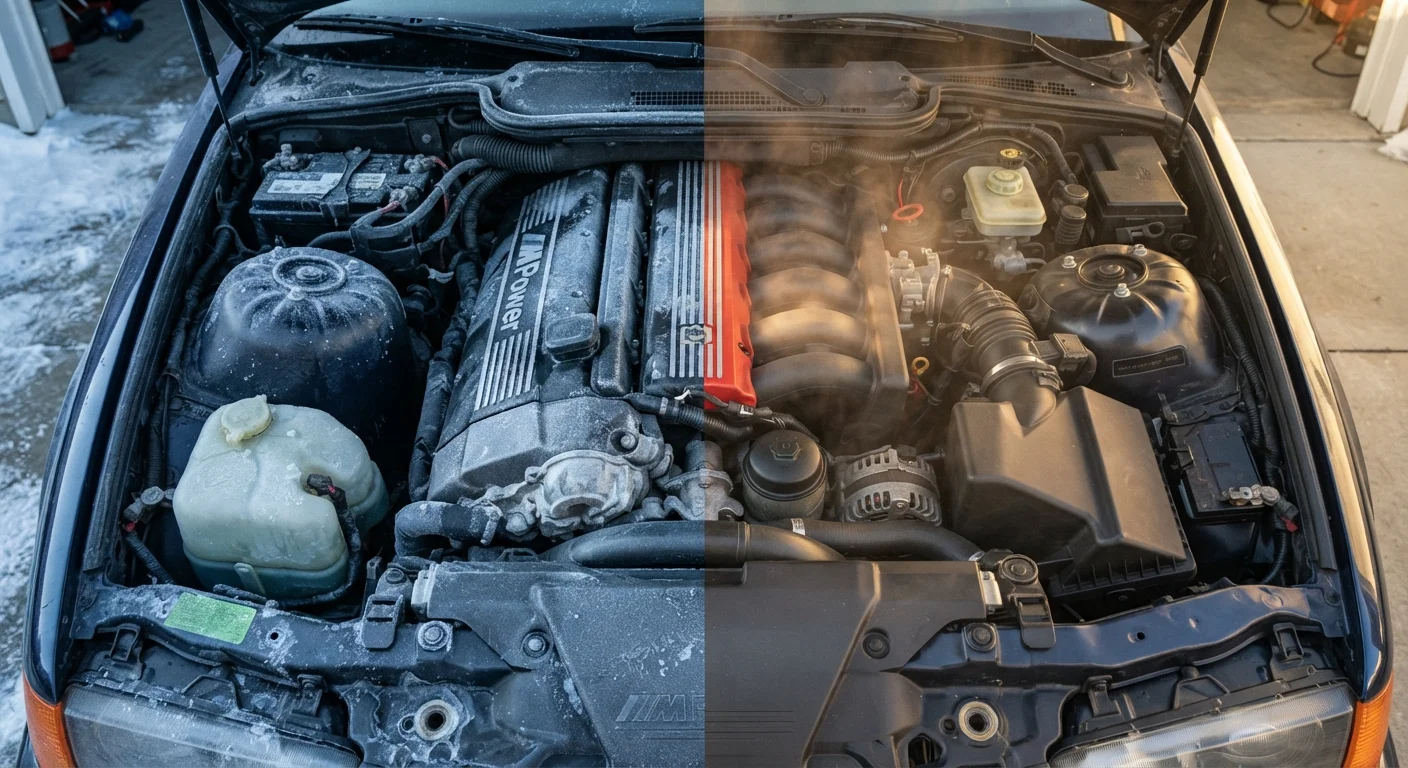
Extreme temperatures stress multiple vehicle systems simultaneously. This article explains the science behind those effects and how to prepare.
Key takeaways
- Cold thickens engine oil and slows battery chemistry, making cold starts the hardest moment for any vehicle.
- Heat accelerates fluid oxidation and breakdown, particularly in engine oil and brake fluid.
- Tyre pressure drops roughly 1 PSI for every 10 degrees Fahrenheit of temperature decrease.
- A battery that performs acceptably in moderate weather can fail completely in freezing temperatures.
- Coolant must be mixed correctly to protect against both freezing and boiling, not just one extreme.
- Checking fluids and tyre pressure before temperature extremes arrive is more effective than reacting after a problem appears.
What temperature actually does to engine oil
Engine oil protects metal surfaces by maintaining a film between moving parts. Its ability to do that depends on viscosity, the resistance to flow. Cold thickens oil, slowing its circulation at startup. In the first seconds after a cold start, parts that depend on oil pressure receive less lubrication than at normal operating temperature. This is why short cold-weather trips, where the engine never fully warms, accumulate wear faster than highway driving.
Heat works in the opposite direction. Thin oil at very high temperatures loses its film strength. Beyond that, sustained high temperatures oxidize oil, breaking down its additive package and forming sludge. Synthetic oils generally handle both extremes better than conventional oils, but all oil degrades over time regardless of temperature history.
Multi-grade oil designations, such as 5W-30, describe this behavior directly. The number before the W (winter) indicates low-temperature flow; the number after describes viscosity at operating temperature. Using the viscosity grade specified in your owner's manual gives the engine oil that behaves within its design parameters across the expected temperature range for your climate.
Battery chemistry under thermal stress
A standard lead-acid battery generates electricity through a chemical reaction between lead plates and sulfuric acid electrolyte. That reaction slows in cold temperatures, reducing the current the battery can deliver. Cranking a cold, thick-oil engine demands more current at exactly the moment the battery produces less. The gap between what the engine needs and what the battery can supply narrows with age: a battery at 70 percent of its original capacity may start a car fine at 70 degrees Fahrenheit but fail at 15 degrees.
~40%
Battery capacity at 0 degrees Fahrenheit vs. 80 degrees Fahrenheit
A standard lead-acid battery delivers significantly less cranking current in freezing conditions, per published data from battery manufacturers' cold-cranking amp testing standards.
1 PSI
Tyre pressure drop per 10 degrees Fahrenheit temperature decrease
This relationship follows basic gas law physics and is consistent across passenger vehicle tyre sizes.
3 to 5 years
Typical automotive battery lifespan
Actual lifespan varies with climate, driving patterns, and electrical load; heat shortens battery life more than cold does over the long term.
Heat stresses batteries differently. High temperatures accelerate corrosion inside the battery and cause water in the electrolyte to evaporate, permanently reducing capacity. Batteries in hot climates often fail earlier than those in cold climates, even though cold-weather failure is more dramatic and better known.
Most batteries last three to five years. Having a battery load-tested, not just voltage-checked, before winter gives a reliable picture of remaining capacity. Many auto parts retailers and repair shops offer this service at no charge. For a deeper look at how automotive batteries work, see our explainer on battery health and cranking power.
Tyre pressure and rubber compounds across seasons
Air inside a tyre contracts in cold and expands in heat, following basic gas physics. Tyre pressure drops approximately 1 PSI for every 10 degree Fahrenheit decrease in ambient temperature. A tyre correctly inflated at 35 PSI on a 70-degree day will read around 31 to 32 PSI when temperatures fall to 30 degrees. That is enough to affect handling, fuel consumption, and tyre wear.
Underinflated tyres flex more with each rotation, generating heat internally. In summer, when ambient temperatures are already high, that additional heat accelerates rubber degradation and raises the risk of a blowout. Overinflated tyres, which can result from adding air on a cold day and then driving into warmer conditions, reduce the contact patch with the road and compromise braking distances.
The rubber compound itself changes with temperature. At very low temperatures, conventional summer tyre compounds stiffen and grip decreases measurably. Winter tyre compounds are formulated to stay pliable below 45 degrees Fahrenheit, which is why they outperform all-season tyres in severe cold. Adjusting your driving for weather conditions also matters when grip is reduced, regardless of tyre type.
Coolant, brake fluid, and other fluids worth watching
Coolant (antifreeze) prevents both freezing and boiling. A 50/50 mix of ethylene glycol coolant and distilled water protects to roughly minus 34 degrees Fahrenheit and raises the boiling point above 265 degrees Fahrenheit with a pressurized system. Straight water or an improperly diluted mix loses protection at both ends. Coolant also contains corrosion inhibitors that deplete over time, which is why most manufacturers recommend flushing it on a set interval rather than simply topping it off. Our coolant check and top-up guide covers how to do this safely.
Brake fluid absorbs moisture from the air over time, a property called hygroscopicity. As moisture content rises, the fluid's boiling point falls. In hot weather or during heavy braking, degraded brake fluid can vaporize in the lines, creating a compressible gas pocket that produces a spongy pedal. This is not a gradual performance issue; it can become an acute safety problem. Most manufacturers recommend replacing brake fluid every two years regardless of mileage.
Windshield washer fluid is often overlooked until it freezes in the reservoir or lines. Standard summer washer fluid freezes at 32 degrees Fahrenheit. Winter-rated fluid is formulated to stay liquid well below that and also helps clear ice from the windshield. Switching before the first freeze costs little and prevents a blocked washer system when you need it most.
A pre-trip vehicle check that covers these fluids before seasonal temperature changes is more practical than waiting for a warning light or a failed start.
Frequently Asked Questions
The content on this site is for informational purposes only and is not a substitute for professional advice. Always consult a qualified professional for guidance specific to your situation.