
Keeping a Service Log: Why Documentation Protects Your Vehicle and Your Wallet

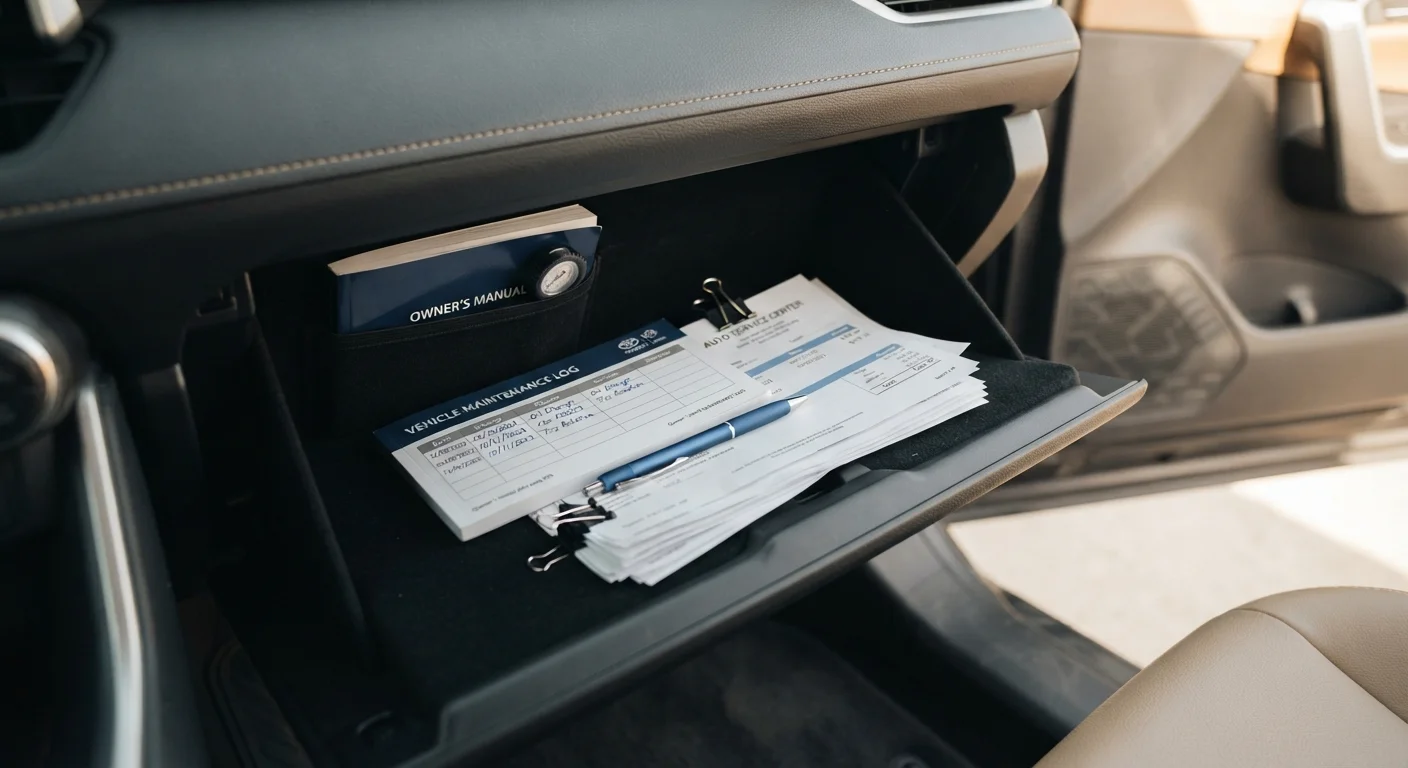
A well-kept service record helps diagnose problems faster, supports warranty claims, and retains resale value. Learn what to record and how.
Key takeaways
- A service log creates a verifiable maintenance history that supports warranty claims and dispute resolution.
- Consistent documentation helps mechanics diagnose recurring or intermittent problems faster.
- A well-maintained service record can increase a vehicle's resale value and reduce buyer negotiation leverage.
- Both physical logbooks and digital apps work; consistency matters more than format.
- Recording mileage, date, work performed, and cost is the minimum useful entry for any service event.
What a service log actually is
A service log is a running record of every maintenance and repair event performed on a vehicle. It goes beyond the sticker on your windshield. A complete log captures the date, odometer reading, work performed, parts used or replaced, cost, and which shop or technician completed the job.
Most new vehicles come with a manufacturer-issued maintenance booklet, but that booklet only has space for official dealer stamps. A separate log fills in everything else: the tire rotation at an independent shop, the battery replacement at a parts store, the fluid top-off you did yourself at home. Those events matter just as much to a future mechanic or buyer, and they often go unrecorded.
The log does not need to be elaborate. A small notebook, a spreadsheet, or a dedicated app all work equally well. What matters is that every service event gets entered while the details are fresh.
Why documentation protects you financially
Warranty coverage, both the manufacturer warranty and any extended service contract, typically requires proof that maintenance was performed on schedule. If a covered component fails and you cannot show that related maintenance was kept current, a claim can be denied. A service log with dated receipts attached is the clearest form of that proof.
The financial protection extends to resale. A vehicle with documented history routinely attracts stronger buyer interest than an identical car with no records. Buyers who cannot verify how a car was maintained often assume the worst and push for a lower price. The service log removes that uncertainty. If you ever plan to sell privately or trade in, those records give you a factual basis for your asking price. See our checklist of questions buyers should ask before signing to understand what informed buyers will look for when reviewing a vehicle's history.
Record the odometer reading for every service entry, not just the date.
Many maintenance intervals are mileage-based, not time-based. A date alone cannot tell you whether an oil change is overdue if you drive irregularly. Mileage entries make interval calculations accurate and give a mechanic or buyer an honest picture of how the vehicle has been used.
Keep receipts attached to or referenced from each log entry.
A log entry without a supporting receipt is difficult to verify during a warranty dispute. Receipts confirm the specific parts used, the shop that performed the work, and the exact cost, all of which can matter in a claim or resale negotiation.
Note any symptoms or concerns observed at the time of each service.
A vehicle can develop problems gradually. Noting a minor vibration or an occasional warning light at the time of an oil change creates a timestamped record that can help a technician identify when a problem started and whether previous work is relevant.
Log parts replaced during DIY maintenance with the same detail used for shop work.
Home maintenance is often invisible to the service history unless it is recorded. Missing DIY entries create gaps that make the log appear incomplete and can leave you unable to prove a part was replaced when a related warranty issue arises.
Review the log before every shop visit.
A quick review before dropping a car off surfaces what was recently completed and what is coming due. This prevents duplicate services and helps you ask informed questions about what the shop recommends versus what has already been addressed.
Documentation also matters for tax purposes if the vehicle is used for business. Accurate mileage logs and repair records support deduction claims if the IRS ever questions them.
How documentation speeds up diagnosis
Mechanics work faster when they have context. A driver who can say "the oil was changed 4,200 miles ago, the coolant was flushed last spring, and this noise started two weeks after the last brake job" gives a technician a meaningful starting point. Without that context, a technician has to assume nothing has been done and run broader checks, which costs time and money.
Intermittent problems are particularly difficult to diagnose from a cold start. A service log that shows a pattern, such as the same warning light appearing every few months despite repeated resets, tells a story that a single shop visit cannot. It also protects you if a repair fails to fix the problem. Having written records of what was already tried prevents paying twice for the same unsuccessful fix.
For drivers who handle routine maintenance themselves, the log provides the same value. Knowing when you last checked the brake fluid or rotated the tires takes the guesswork out of deciding what is due next. Our guide to essential fluid checks and the year-round maintenance schedule are useful companions for knowing what to log and when.
Best practices for keeping a reliable log
Enter every service event within 48 hours of completion. Memory degrades quickly, and mileage figures are easy to misremember. If a receipt was issued, staple or clip it to the logbook page or scan it into the same digital folder as your entries.
Record self-performed maintenance with the same detail as shop work. Note the product name, quantity used, and where you sourced the part if applicable. This matters for warranty purposes: some warranties require that parts meet specific standards, and a record showing you used a compliant product can be just as valid as a shop receipt.
Keep the log in the vehicle or in a consistent digital location. A log left at home does nothing for a roadside emergency or an unexpected shop visit. If you use an app, make sure it is backed up automatically so a phone replacement does not erase the history.
Pair your log habits with a regular inspection routine. Our pre-trip vehicle check guide covers what to look for before any drive, and commonly overlooked maintenance checks covers items like wiper blades and exterior lights that rarely make it into standard service records but belong there. Battery condition is another item worth noting each time it is tested; see our battery health explainer for what figures to record.
The content on this site is for informational purposes only and is not a substitute for professional advice. Always consult a qualified professional for guidance specific to your situation.