
Spark Plugs: What They Do, How They Wear, and When They Need Replacing

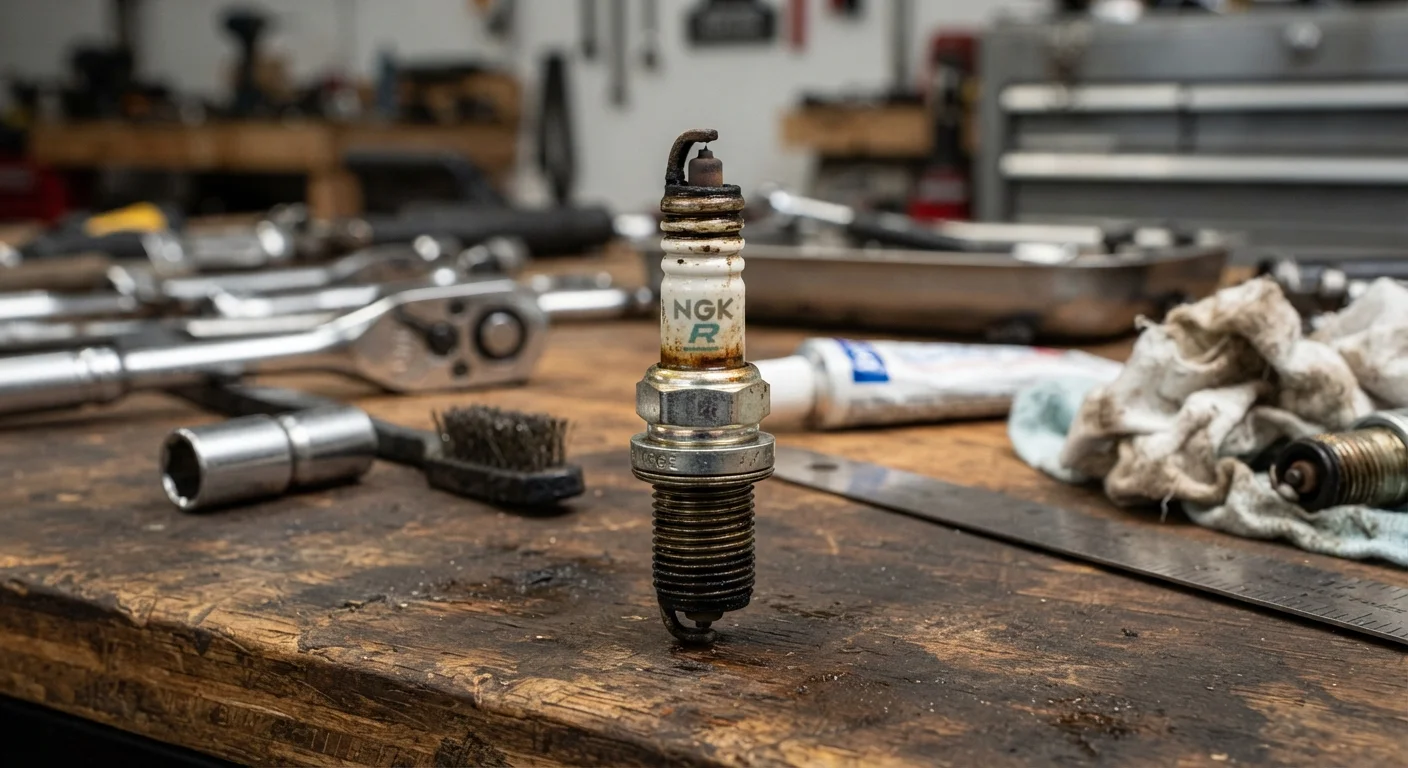
Worn spark plugs affect fuel economy and starting reliability before they fail completely. Learn the signs and what replacement intervals typically involve.
What a spark plug actually does
A spark plug has one job: ignite a compressed mixture of air and fuel inside a cylinder. It does this by generating a small electrical spark across a gap between two electrodes. That spark fires thousands of times per minute under extreme heat and pressure, so the materials and tolerances involved matter more than the plug's simple appearance suggests.
The plug connects to the ignition coil or distributor, receives a high-voltage pulse, and discharges it across the electrode gap. Combustion follows, the piston is pushed down, and the engine produces power. Each cylinder has its own plug, so a four-cylinder engine has four; a six-cylinder has six.
Because ignition timing depends on the spark arriving at exactly the right moment, a plug that misfires or fires weakly disrupts the entire combustion cycle, not just one cylinder. The effects spread to fuel economy, exhaust emissions, and engine smoothness. Timing belt and chain condition also affects when that spark fires relative to piston position, which is why ignition and valvetrain maintenance are connected.
Electrode gap
The measured space between the center and ground electrodes of a spark plug. The gap must be within a precise specification for the plug to fire reliably; too wide or too narrow affects combustion.
Heat range
A rating that describes how quickly a spark plug transfers heat away from the firing tip. An incorrect heat range can cause fouling at the cool end or pre-ignition damage at the hot end.
Misfire
A combustion event that fails to ignite the air-fuel mixture fully or at all. Misfires produce rough running, increased emissions, and can damage the catalytic converter over time.
Carbon fouling
A buildup of black, sooty deposits on spark plug electrodes caused by incomplete combustion. Fouled plugs fire inconsistently and may accelerate engine wear.
Iridium plug
A spark plug type that uses an iridium alloy center electrode, which is harder and more corrosion-resistant than copper or platinum. Iridium plugs generally have longer service intervals.
How spark plugs wear over time
The electrode gap widens gradually as metal erodes with each discharge. A wider gap requires a higher voltage to jump, and the ignition system may not always supply enough. The result is incomplete combustion, which shows up as rough idle, hesitation during acceleration, or a noticeable drop in fuel economy before the plug fails outright.
Four wear patterns appear most often:
- Normal wear: light tan or gray deposits, uniform erosion on the center electrode. The plug is doing its job and approaching the end of its service life.
- Carbon fouling: black, sooty deposits caused by a rich fuel mixture, excessive idling, or oil entering the combustion chamber. The plug may still fire but with less reliability.
- Oil fouling: wet, oily deposits indicating oil is leaking past worn valve seals or piston rings. Replacing the plug alone will not fix the underlying problem.
- Pre-ignition damage: melted or blistered electrodes from combustion temperatures that are too high, often caused by incorrect heat range, engine knock, or cooling system issues.
Reading the plug's condition before discarding it can flag problems that go beyond routine maintenance. A mechanic can interpret those deposits and confirm whether the engine itself needs attention.
| Copper plug service interval | ~30,000 miles (General manufacturer guidance; check your owner's manual) |
| Platinum plug service interval | ~60,000 miles (General manufacturer guidance; check your owner's manual) |
| Iridium plug service interval | 100,000+ miles (General manufacturer guidance; check your owner's manual) |
| Cylinders per plug | 1 plug per cylinder |
| Common misfire symptom | Rough idle or engine hesitation |
Replacement intervals and what affects them
Replacement intervals vary by plug type. Conventional copper-core plugs typically need replacement every 30,000 miles. Platinum plugs are rated for roughly 60,000 miles, and iridium plugs are commonly specified at 100,000 miles or more. These figures come from manufacturer specifications and assume normal operating conditions.
Several factors shorten intervals in practice. Frequent short trips prevent the engine from reaching full operating temperature, which accelerates fouling. Towing or sustained high-load driving increases combustion heat. An engine that burns oil, runs rich, or has cooling system trouble will consume plugs faster regardless of material.
Your owner's manual lists the correct plug type and interval for your specific engine. Using a plug with the wrong heat range, the wrong gap measurement, or the wrong thread reach can cause misfires, damage to the cylinder head, or pre-ignition. Always confirm specifications before purchasing a replacement set.
If your vehicle is hard to start on cold mornings or the battery checks out healthy, worn plugs are a reasonable suspect. Battery condition and ignition health overlap in their symptoms, so confirming both is worthwhile when diagnosing a starting problem.
Check your owner's manual first
Spark plug specifications vary by engine, not just by vehicle make. The owner's manual lists the correct plug type, gap measurement, and replacement interval for your specific engine. Using a substitute plug that does not match those specifications can introduce new problems rather than solving old ones.
DIY replacement versus professional service
On many four-cylinder engines, spark plug replacement is accessible to a careful home mechanic with basic tools: a ratchet, a spark plug socket with a rubber insert, a torque wrench, and a gap tool. The job requires working on a cool engine, removing ignition coils or wires one at a time to avoid mix-ups, and torquing the new plugs to the manufacturer's specification rather than guessing by feel.
Several situations call for professional service instead. Engines with plugs buried under intake manifolds, coil packs, or tight firewall clearances are significantly harder to access without risking damage. V6 and V8 engines often have rear cylinders that require removing components to reach. Aluminum cylinder heads are also prone to thread damage if a plug is over-torqued or cross-threaded, and a damaged thread insert is a far more expensive repair than the original plug job.
If you notice a misfire warning light, rough running, or a sudden drop in fuel economy, have the vehicle inspected rather than waiting for a scheduled interval. Ignoring a misfiring cylinder strains the catalytic converter and can cause damage beyond what worn plugs alone would cause.
The content on this site is for informational purposes only and is not a substitute for professional advice. Always consult a qualified professional for guidance specific to your situation.