
Compound Interest in Practice: How Growth Builds on Itself Over Time

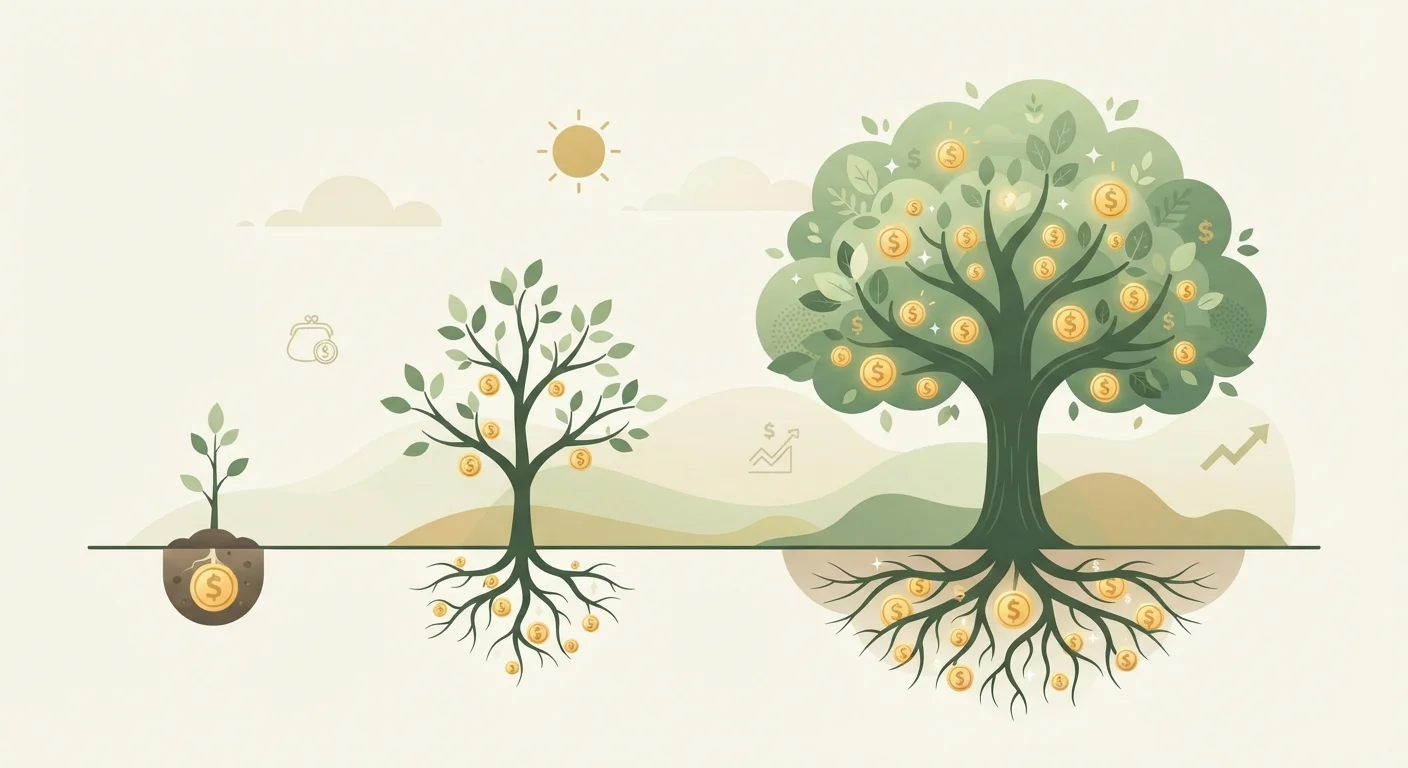
A clear look at compounding, why time in the market matters so much, and how the concept applies to real investment accounts.
Key takeaways
- Compound interest applies to both the original principal and previously earned interest, so growth accelerates over time.
- Time is the most important variable in compounding: starting earlier produces dramatically larger outcomes than starting later.
- Investment fees and inflation both compound in the same way, working against your balance rather than for it.
- Consistent contributions amplify compounding by adding new principal that also begins earning returns.
- Compounding works in debt too, meaning high-interest balances grow the same way investments do.
What compounding actually means
Most people have heard that compound interest is powerful, but the mechanism is simple enough to state plainly. When you invest money and earn a return, that return gets added to your balance. The next time a return is calculated, it is calculated on the new, larger balance, not just the original amount. This cycle repeats continuously.
A basic illustration: $1,000 earning 7% in the first year produces $70. In the second year, the 7% applies to $1,070, producing $74.90. The difference seems small, but after 30 years at 7%, that initial $1,000 grows to roughly $7,600 without adding a single additional dollar. That is the compounding cycle at work.
For a fuller picture of why investing matters in the first place, see what investing means and why it matters.
Compounding applies in tax-advantaged accounts too
In accounts like a 401(k) or IRA, returns are not taxed each year as they accumulate. This means the full gross return stays invested and compounds, rather than being reduced by annual taxes. The tax structure of the account affects how much of each return actually stays in the compounding cycle. Consult a tax professional for guidance specific to your situation.
Why time is the critical variable
The most important input in compounding is not the interest rate. It is time. Each additional year gives the previous growth more time to generate its own growth. The longer the period, the steeper the curve becomes.
Consider two people who each invest $5,000 and earn an identical 7% annual return. One starts at age 25 and stops contributing after 10 years. The other waits until age 35 and contributes for 30 years. Counterintuitively, the person who started earlier but contributed for fewer years often ends up with more, simply because those early years of compounding had decades to run.
This is why starting to invest in your twenties carries a structural advantage that is very hard to replicate by contributing larger amounts later.
$76,122
Growth of $10,000 over 30 years at 7%
At a 7% annual return with no additional contributions, $10,000 grows to approximately $76,000 over 30 years due to compounding alone.
10 years
Typical time for money to double at 7%
The Rule of 72 is a rough estimate: divide 72 by the annual return rate to approximate years for money to double, so 7% implies roughly 10 years.
1%
Fee difference that can cost tens of thousands over decades
Financial research consistently shows that a 1 percentage point difference in annual fees can reduce a portfolio's final value by tens of thousands of dollars over a 30-year horizon.
How contributions interact with compounding
A single lump sum illustrates the concept cleanly, but most people invest by contributing regularly over time, through payroll deductions into a retirement account, for instance. Each contribution becomes its own compounding base. Money added in year five begins compounding from that point forward, while money added in year one has had five full years of growth already.
This interaction between regular contributions and compounding is one reason consistency matters as much as amount. Stopping contributions for even a few years removes potential principal that would have compounded for the remaining investment horizon.
The choice between putting in a lump sum and spreading contributions over time has its own tradeoffs, which this comparison of lump sum versus regular contributions covers in detail.
The forces that work against compounding
Two factors compound against your balance in the same way returns compound for it: fees and inflation.
Investment fees are deducted from your account, reducing the balance that generates future returns. A 1% annual fee sounds small, but applied to a growing balance over decades, it can remove a substantial portion of total wealth accumulated. Understanding how investment fees compound over time is worth doing before selecting any account or fund.
Inflation reduces purchasing power at a compounding rate too. A nominal return of 7% in an environment of 3% inflation produces a real return closer to 4%. This is why simply holding cash in a low-yield account, while stable in dollar terms, may lose ground in real terms over long periods.
High-interest debt is a third force. Credit card balances that carry unpaid interest accumulate in exactly the same exponential pattern as an investment, but the growth works against the borrower. Paying down high-rate debt before increasing investment contributions is a reasonable financial priority for many households. The saving and debt hub covers practical approaches to managing both at once.
Putting the concept into practice
Understanding compounding is useful only if it changes behavior. A few practical implications follow directly from how compounding works.
Reinvesting dividends rather than withdrawing them keeps earnings in the compounding cycle. Most brokerage and retirement accounts allow automatic dividend reinvestment. Leaving money invested during market downturns matters because exiting and re-entering the market disrupts the continuous compounding process. What market volatility actually means for long-term investors explains why staying the course tends to serve investors better than reacting to short-term price swings.
Finally, lifestyle inflation can quietly erode the amount available to invest each year. When income rises but contributions stay flat, the compounding base grows more slowly than it could. Lifestyle inflation and its effect on savings is worth reading alongside this concept.
This article is for general informational and educational purposes only and does not constitute financial or investment advice. Consult a qualified financial adviser before making decisions about your own investments or financial situation.
Frequently Asked Questions
The content on this site is for informational purposes only and is not a substitute for professional advice. Always consult a qualified professional for guidance specific to your situation.