
Lifestyle Inflation and Why Rising Income Does Not Always Mean Rising Savings

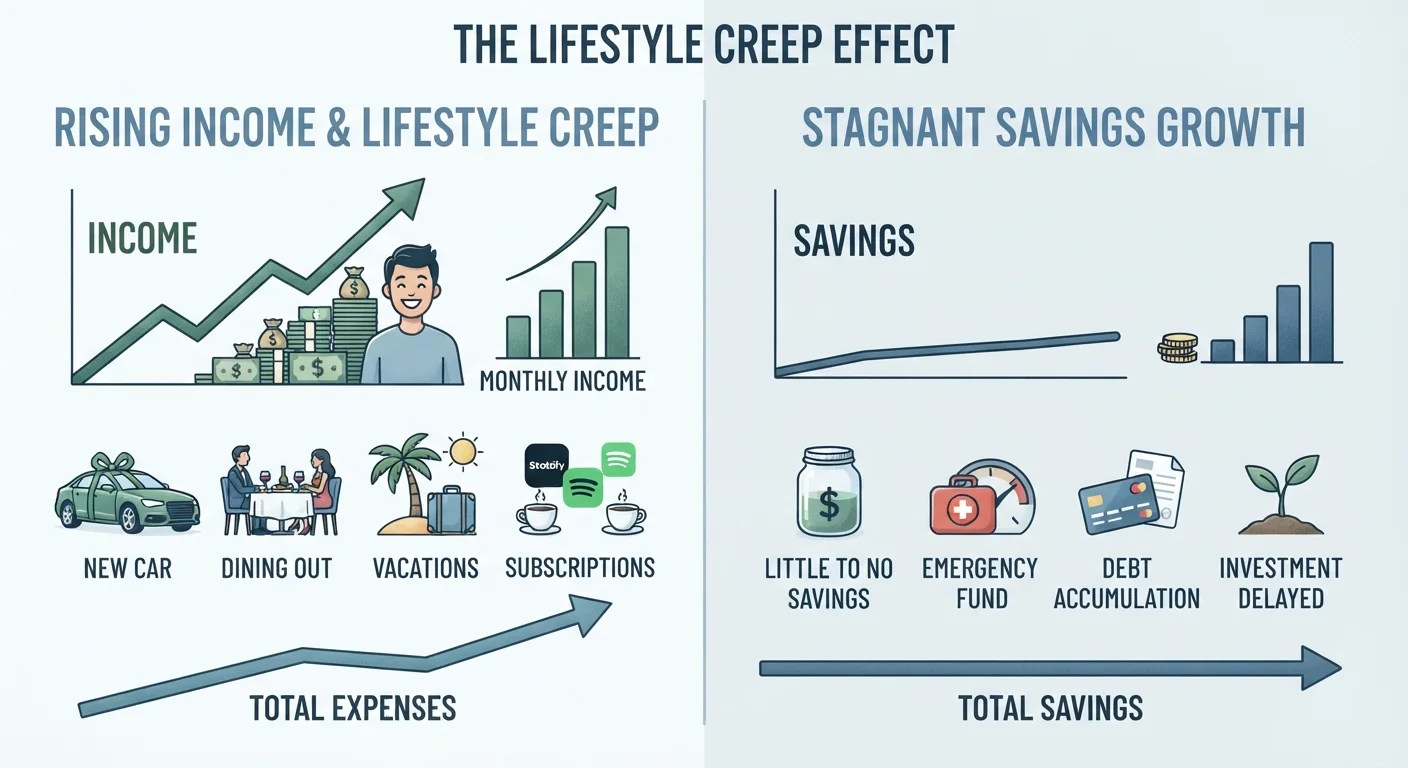
Earning more should accelerate savings, but lifestyle inflation often absorbs the difference. Learn what it is, why it happens, and how to counteract it.
Key takeaways
- Lifestyle inflation happens when new spending rises in step with new income, leaving savings unchanged.
- Hedonic adaptation makes higher spending feel normal quickly, which makes the pattern hard to notice.
- Automating savings before discretionary spending can interrupt the cycle.
- Tracking your savings rate is a practical way to measure whether raises are actually reaching your goals.
- Carrying existing debt makes lifestyle inflation more costly because interest compounds on balances that do not shrink.
What lifestyle inflation looks like in practice
Picture someone earning $50,000 a year who saves roughly $300 a month. They get a raise to $65,000. Instead of directing most of that $15,000 increase toward savings or debt, they move into a larger apartment, start eating out more often, and upgrade their car. Monthly savings climb to $350. The raise was substantial, but the financial position barely moved.
This is lifestyle inflation. The numbers change, but the ratio does not. It is not about extravagance. Many of the new expenses feel reasonable at the time: a nicer commute, meals that save time, a gym membership. The issue is that they arrive all at once when income rises, leaving little room for savings to catch up.
Hedonic adaptation speeds this along. Once a higher standard of living becomes familiar, it no longer feels like a luxury. Cutting it back feels like a sacrifice, even though it was recently unaffordable. That psychological shift is what makes lifestyle inflation sticky.
Set your savings allocation before you adjust spending
When a raise arrives, decide on a savings or debt repayment transfer amount before making any lifestyle changes. Once new spending habits form, they are much harder to reverse. Treating the allocation decision as the first step, not an afterthought, is the most effective way to capture real financial progress from income growth.
Why this matters more when you carry debt
For anyone balancing existing debt with savings goals, lifestyle inflation carries extra weight. Every dollar absorbed by new spending is a dollar not reducing a credit card balance or student loan. Interest on those balances compounds continuously, so delayed repayment has a real cost that grows over time.
Compound interest works in both directions. When it applies to savings or investments, it grows wealth. When it applies to unpaid debt, it erodes it. A raise that disappears into lifestyle spending rather than debt repayment leaves that compounding effect working against you longer.
Your savings rate is one of the clearest ways to track whether income growth is actually translating into financial progress. If the rate stays flat across two or three pay increases, lifestyle inflation is almost certainly the cause.
~70%
Americans living paycheck to paycheck
A 2023 LendingClub report found that roughly 70 percent of U.S. consumers reported living paycheck to paycheck, including many high earners, illustrating that income alone does not determine financial stability.
Less than 5%
Personal savings rate in recent years
The U.S. Bureau of Economic Analysis has reported personal savings rates well below 5 percent during stretches of recent years, a sharp drop from rates above 30 percent seen briefly during the early pandemic period.
Practical ways to stop the gap from widening
The most reliable method is to redirect a portion of any raise before it enters a checking account. Automatic transfers to a savings or investment account remove the spending decision entirely. Paying yourself first through automation is especially useful because it does not depend on monthly willpower. The money moves before it can be spent.
A useful rule of thumb: when income rises, direct at least half of the increase toward savings or debt repayment before adjusting any spending. This allows some lifestyle improvement while still capturing real financial progress. It is not about refusing any upgrade; it is about setting a boundary before new habits form.
Building a workable budget also helps, particularly for identifying which new expenses deliver lasting value and which are simply filling the space that extra income opened up. The goal is not to freeze spending permanently, but to be deliberate about which changes stick.
For people with variable income, the same logic applies but requires a percentage-based approach rather than a fixed dollar target. Managing debt and savings on a variable income covers approaches suited to that situation in more detail.
This article is for general informational purposes only and does not constitute personalized financial advice. Consult a licensed financial professional for guidance specific to your situation.
Frequently Asked Questions
The content on this site is for informational purposes only and is not a substitute for professional advice. Always consult a qualified professional for guidance specific to your situation.