
Savings Rate: What It Is, How to Calculate It, and Why It Is a Useful Benchmark

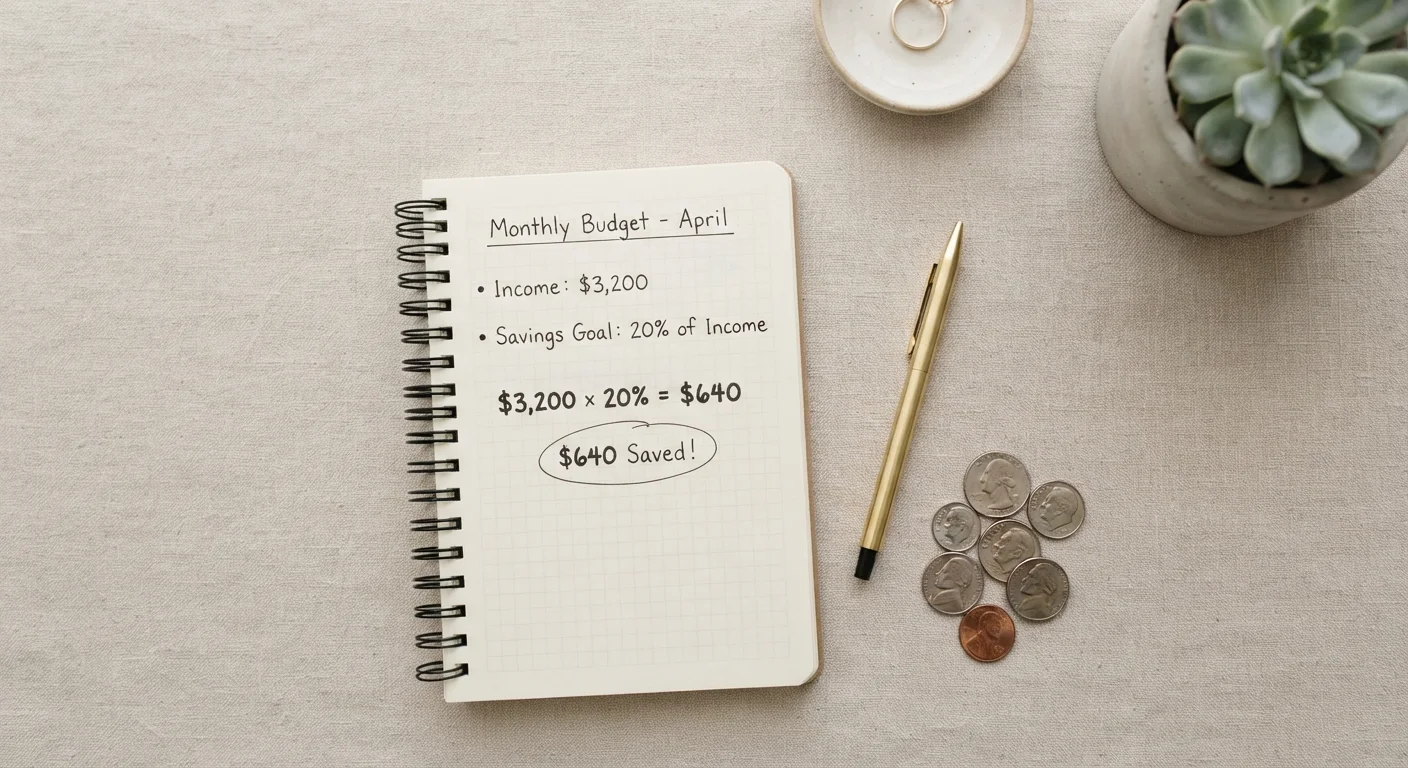
Your savings rate is one of the clearest measures of financial progress. This reference covers the formula, common benchmarks, and what affects it over time.
What your savings rate actually measures
Your savings rate is the percentage of your income that you set aside rather than spend. It is one number that cuts through the noise of budgets, bank balances, and spending habits to show whether you are making real financial progress.
The basic formula is:
Savings Rate = (Amount Saved / Gross or Net Income) x 100
For example, if you bring home $4,000 a month after taxes and save $400, your savings rate is 10%. That figure tells you something a dollar amount alone cannot: how much of what you earn is actually working for your future.
One decision you will need to make upfront is whether to use gross income (before taxes) or net income (take-home pay). Neither is wrong, but net income gives a more realistic picture of what you actually control. Whichever you choose, use it consistently so your rate stays comparable over time.
Debt repayment is a common sticking point. Principal payments on a mortgage or student loan reduce what you owe, so many personal finance frameworks count them as saving. Interest payments, however, are a cost and do not belong in the numerator. If you carry high-interest debt, your real savings rate may be lower than it first appears. The complete framework for managing debt and savings covers how to think about that tradeoff in full.
Common benchmarks and what they mean
The most widely cited rule of thumb is to save 20% of take-home pay, drawn from the 50/30/20 budgeting structure, where 50% covers needs, 30% covers wants, and 20% goes toward savings and debt payoff. That breakdown of needs, wants, and savings is a practical starting point for understanding where each dollar fits.
The 20% target is a benchmark, not a law. A 5% rate still beats a 0% rate. Someone earning $40,000 a year who consistently saves 8% is building more financial security than someone earning $80,000 and saving nothing.
For retirement specifically, many financial planners suggest aiming to replace 70% to 90% of pre-retirement income. The savings rate needed to hit that target depends on when you start, how long you plan to work, and what your investments return over time. Past investment performance does not guarantee future results, so treat projections as rough guides rather than promises.
If your income varies month to month, hitting a fixed percentage is harder. Managing debt and savings on a variable income addresses approaches better suited to unpredictable pay.
What pulls your savings rate up or down
Several forces push and pull on your savings rate over time, and most of them are predictable.
- Fixed expenses: rent, loan payments, and insurance premiums claim income before you have a chance to decide what to do with it. A high fixed-cost load leaves little room to save even with decent earnings.
- Income growth without spending discipline: earning more does not automatically mean saving more. When spending rises in proportion to income, the savings rate stays flat. This pattern is covered in detail in the article on lifestyle inflation and why rising income does not always mean rising savings.
- Debt interest payments: servicing high-interest balances drains cash that could otherwise be saved. Paying down that debt increases the share of income available to redirect.
- Irregular expenses: medical bills, car repairs, and home maintenance can pull the savings rate down in a single month. Tracking your rate as a three- or six-month average smooths out those fluctuations and gives a cleaner read.
Automating transfers to a savings account on payday is one of the most straightforward ways to protect your rate from month-to-month drift. Automating savings and paying yourself first explains the mechanics of setting that up.
This article is for general informational purposes only and does not constitute personalized financial, tax, or investment advice. For decisions specific to your financial situation, consult a qualified financial adviser or other licensed professional.
The content on this site is for informational purposes only and is not a substitute for professional advice. Always consult a qualified professional for guidance specific to your situation.