
Grooming Tools Every Dog Owner Should Understand

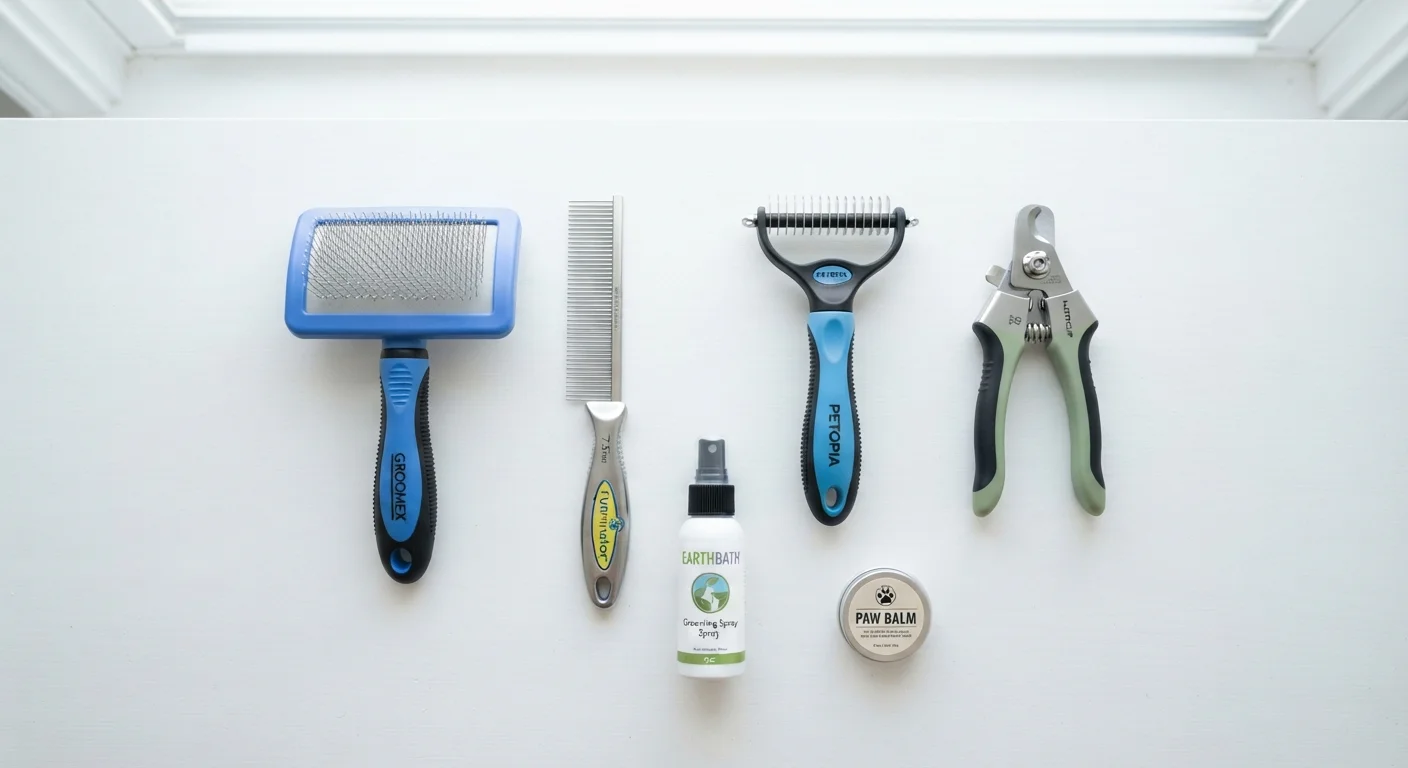
A curated breakdown of common grooming tools, what each is designed for, and how coat type and breed influence which ones are most useful.
Key takeaways
- Coat type determines which grooming tools are appropriate; the wrong tool can damage hair or irritate skin.
- Most grooming problems, including matting and excessive shedding, become harder to manage when sessions are infrequent.
- A slicker brush, metal comb, and nail clipper cover basic grooming needs for most dog breeds.
- Double-coated breeds need different tools than single-coated or wire-coated breeds.
- Regular grooming sessions give owners an opportunity to notice early signs of skin or coat health concerns.
Why tool selection matters more than technique
Many dog owners approach grooming with a single brush purchased at random, then wonder why sessions feel like a struggle. The truth is simpler: grooming goes more smoothly when the tool matches the coat. A slicker brush that works well on a Golden Retriever will do almost nothing useful on a Poodle's curly coat, and a fine-toothed comb pulled through a Siberian Husky's dense undercoat can snap rather than detangle.
Coat structure falls into a few broad categories: short and smooth, long and silky, double-layered, curly or wavy, and wire or rough. Each has different tendencies for matting, shedding, and debris accumulation. Knowing where your dog's coat falls on that spectrum is the first step to choosing tools that actually do the job.
Regular grooming also gives you a consistent, close-up look at your dog's skin. Redness, scaling, unusual lumps, or parasites are easier to spot during a calm brushing session than at any other time. For a fuller look at health habits worth building into your routine, see the Pet Health Basics hub.
Start grooming sessions short and calm
Dogs that are new to regular grooming often accept it more readily when sessions begin with just one or two minutes of gentle brushing rather than a full grooming sequence. Pairing each session with calm praise helps a dog associate the tools with a neutral or positive experience. Once the dog is comfortable, session length can increase gradually. A dog that resists grooming significantly, shakes, or snaps may need a behavioral assessment before grooming can become routine.
The grooming tools dog owners should know
Slicker brush
A slicker brush has a flat or slightly curved pad covered with short, fine wire pins set at an angle. It removes loose hair, light tangles, and surface debris from most coat types. The wire pins reach past the outer coat into the mid-layers without requiring much pressure.
Use a slicker brush on medium to long coats, wavy coats, and the outer layer of double coats. Avoid pressing hard on thin-skinned or short-coated dogs, since firm pressure with wire pins can scratch the skin. Brush in the direction of hair growth first, then gently against the grain to lift the coat if needed.
A slicker brush handles loose hair and surface tangles on most medium and long coats.
Metal comb
A metal comb, sometimes called a greyhound comb, is the most reliable finishing tool available. After using a brush, running a comb through the coat confirms that no tangles remain. If the comb moves through freely from root to tip, the coat is genuinely tangle-free. If it catches, more brushing is needed in that spot.
Combs come with different tooth spacings. Wide-set teeth work on thicker or curlier coats; finer teeth suit silky or thinner coats. Curly-coated breeds such as Poodles and Doodle mixes depend heavily on combing to prevent the small knots that form close to the skin and eventually become mats.
A metal comb is the only reliable way to confirm a coat is fully tangle-free after brushing.
Undercoat rake and deshedding tool
Double-coated breeds have a dense, soft undercoat beneath a coarser outer coat. During seasonal shedding, that undercoat loosens but does not always fall out on its own. An undercoat rake has widely spaced, rounded teeth designed to reach through the outer coat and pull out loose undercoat without cutting or damaging the guard hairs.
Deshedding tools with finer, closely set blades also pull loose undercoat, but they should be used with a light touch and only on dogs whose coat type is appropriate for them. Overuse on a single area, or use on a dog not in a shedding phase, can thin the outer coat. For breeds such as Huskies, Malamutes, and German Shepherds, these tools can meaningfully reduce shedding around the home.
Undercoat rakes remove loose undercoat from double-coated breeds during seasonal shedding.
Dematting comb or rake
A dematting tool has blades or serrated teeth designed to break apart matted sections of coat without requiring the mat to be pulled through intact. Mats form when shed hair becomes tangled with live coat and is not removed, and they can tighten against the skin over time, causing pain and, in severe cases, skin problems beneath the mat.
Use a dematting comb by holding the coat between the mat and the skin to limit pulling, then working the tool through the mat in short strokes. For mats that are tight against the skin or covering a large area, a professional groomer or veterinarian should assess them first. Preventable coat and skin concerns, including those caused by matting, are covered in more depth at common preventable health problems.
A dematting tool breaks apart mats without requiring the entire tangle to be pulled free at once.
Pin brush
A pin brush looks similar to a human paddle brush, with flexible wire pins tipped with small plastic or rubber beads. It is gentler than a slicker brush and works best on long, silky, or flowing coats where the priority is separating strands and adding smoothness rather than removing heavy debris or undercoat.
Afghan Hounds, Yorkshire Terriers, Shih Tzus, and similar breeds respond well to pin brushes used in long strokes following the coat's natural fall. Because the pins flex rather than scrape, a pin brush is also a reasonable choice for a dog that is sensitive to harsher tools, though it will not reach deep enough to manage undercoat or detect hidden tangles on its own.
A pin brush separates and smooths long silky coats without the scraping action of wire-pin slicker brushes.
Nail clippers and grinder
Overgrown nails alter how a dog distributes weight across its paws and can eventually affect posture and joint comfort. Nail clippers for dogs come in two main styles: scissor-type and guillotine-type. Both cut the nail cleanly when sharp; dull blades crush rather than cut, which can crack the nail or cause discomfort.
A nail grinder uses a rotating abrasive tip to file the nail down gradually. Some dogs tolerate the vibration and sound of a grinder better than the pressure of clippers, while others prefer clippers. The main risk with either tool is cutting into the quick, which is the blood vessel running through the nail. On dogs with light-colored nails, the quick is visible as a pink area. On dark nails, grinding or clipping in small increments and stopping when a dark circle appears in the center of the cut surface helps avoid cutting too deep. If you are uncertain, a veterinarian or groomer can demonstrate proper technique.
Overgrown nails can affect a dog's posture and joint comfort over time.
Choosing the right combination from the list above is more straightforward once you know your dog's coat type. A short-coated Beagle needs little beyond a bristle brush and nail clippers. A long-coated Afghan Hound needs a pin brush, a wide-tooth comb, and probably a dematting rake used before every brushing. Double-coated breeds such as German Shepherds and Samoyeds need an undercoat rake or deshedding tool during seasonal coat blows, in addition to a slicker brush for surface maintenance.
If you share your home with multiple pets on different grooming schedules, building a consistent daily routine can help prevent grooming from becoming a bottleneck in your week.
This article provides general educational information about pet grooming tools and is not a substitute for advice from a licensed veterinarian or professional groomer. If your dog has a skin condition, coat disorder, or behaves with significant distress during grooming, consult a qualified professional.
The content on this site is for informational purposes only and is not a substitute for professional advice. Always consult a qualified professional for guidance specific to your situation.