
Reading a Pet Food Label: Ingredients, Guaranteed Analysis, and What to Ignore

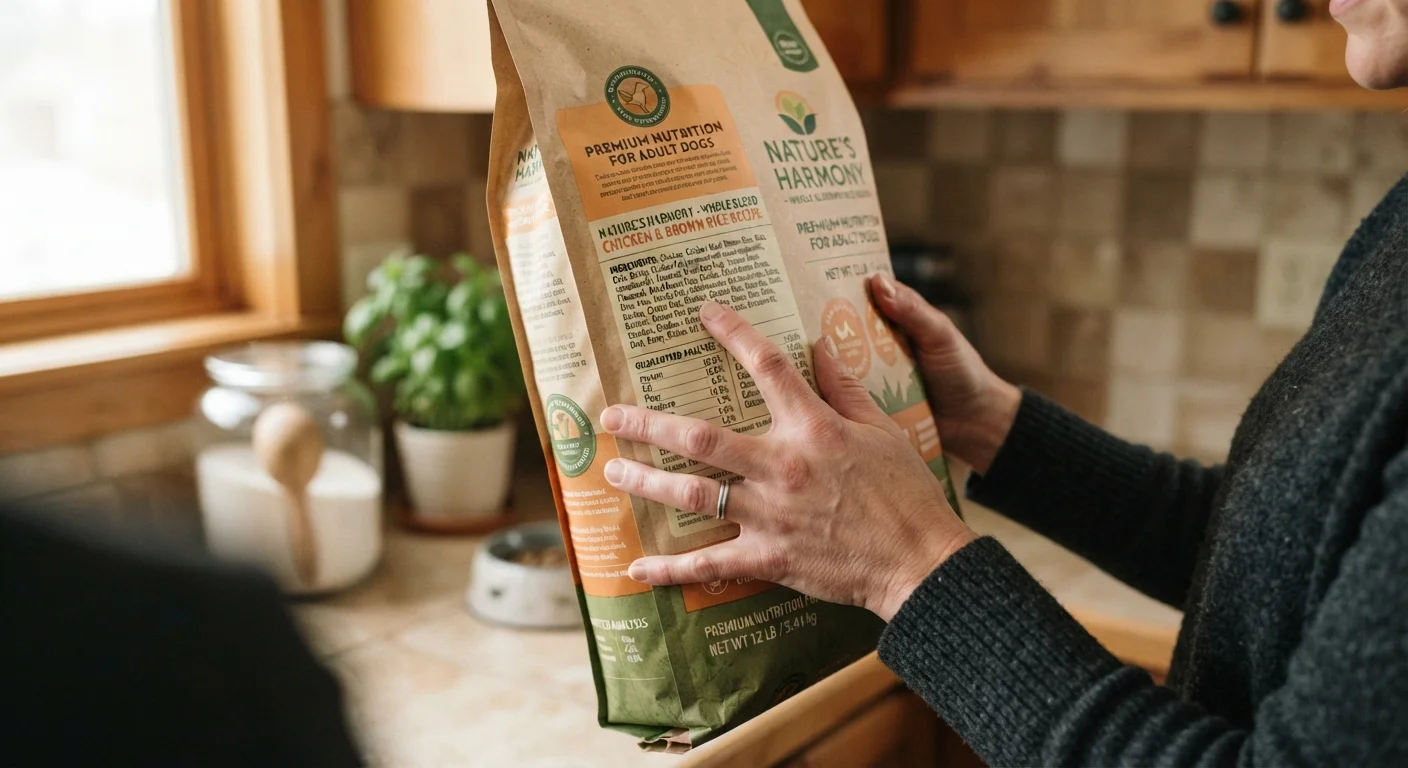
Pet food packaging can feel like a puzzle. Learn what the key sections of a label actually mean and how to make sense of ingredient lists.
Key takeaways
- Ingredients are listed by weight before processing, so moisture content affects their order significantly.
- The guaranteed analysis shows minimum or maximum nutrient percentages, not exact amounts.
- AAFCO nutritional adequacy statements tell you whether a food was formulated or tested to meet a pet's needs.
- Front-of-pack marketing claims like 'natural' or 'premium' have no standardized legal definition in pet food.
- Ingredient count and order alone cannot tell you whether a diet is nutritionally complete.
What a pet food label is legally required to include
In the United States, pet food labeling is regulated at the federal level by the AAFCO and at the state level by individual state departments of agriculture. Together, these bodies require that every commercial pet food label include six core elements: the product name, the net weight, the manufacturer's name and address, the ingredient list, the guaranteed analysis, and a nutritional adequacy statement.
Understanding which sections are regulated and which are marketing gives you a reliable filter. The ingredient list, guaranteed analysis, and AAFCO statement carry real information. The front of the bag, including product names and descriptors like 'wholesome' or 'premium,' is almost entirely unregulated and can be ignored when assessing nutritional quality.
For a broader look at how feeding decisions connect to your pet's overall health, the Pet Care and Feeding hub covers nutrition, hydration, and daily routines in one place.
How to read the ingredient list
Ingredients appear in descending order by weight as measured before cooking or processing. This is called pre-moisture weight, and it has a practical consequence: a whole meat like chicken or beef contains a large amount of water. Once the moisture is cooked away, that ingredient may represent far less of the final product than its position at the top of the list suggests.
Meat meals, by contrast, have already had moisture removed, so 'chicken meal' at position three may contribute more protein by dry weight than 'chicken' at position one. Neither placement is inherently deceptive; both are governed by the same pre-processing weight rule.
Ingredient splitting is worth knowing. If a manufacturer lists 'ground corn,' 'corn gluten meal,' and 'corn bran' separately, each appears lower on the list than a single combined corn entry would. This is a real practice, though it does not by itself make a food unsafe or nutritionally poor. What matters is the overall nutrient profile, not the order of any single ingredient.
Use the ingredient list alongside the guaranteed analysis
The ingredient list tells you what is in the food; the guaranteed analysis tells you how much of key nutrients are present. Neither section alone gives the full picture. Reading both together, along with the AAFCO statement, gives you a much more accurate read on a food's actual nutritional value.
If you want to evaluate a food's protein source accurately, look at the guaranteed analysis alongside the ingredient list, not the ingredient list alone. The complete guide to cat nutrition and feeding explains how protein requirements differ by life stage for cats specifically.
Decoding the guaranteed analysis
The guaranteed analysis panel lists four nutrients at minimum: crude protein (minimum), crude fat (minimum), crude fiber (maximum), and moisture (maximum). Some labels include additional guarantees for nutrients like calcium, phosphorus, or omega fatty acids.
These numbers are not averages or exact values. They are legal floors and ceilings. A label stating '26% crude protein minimum' means the food contains at least that amount, but the actual level could be higher. This makes direct label-to-label comparisons tricky when foods have different moisture levels.
To compare a wet food to a dry food, you need to convert both to a dry matter basis. Subtract the moisture percentage from 100 to get the dry matter percentage, then divide the nutrient amount by that figure and multiply by 100. For example, a wet food with 78% moisture and 8% crude protein contains roughly 36% protein on a dry matter basis, which is comparable to many dry foods.
For context on how these numbers connect to weight and caloric management, see what owners often get wrong about pet weight management.
The AAFCO nutritional adequacy statement
This is the most functionally important line on the label for everyday pet owners. The AAFCO statement tells you two things: which life stage the food is intended for, and how that claim was established.
There are two methods. The first is formulation: the manufacturer calculated that the recipe meets AAFCO nutrient profiles on paper. The second is feeding trial: the food was fed to animals under controlled conditions and the animals maintained health according to defined criteria. A feeding trial statement provides stronger real-world evidence, though formulation-based foods are not automatically inferior.
Look for language like 'Animal feeding tests using AAFCO procedures substantiate that provides complete and balanced nutrition for .' If a label says 'for supplemental or intermittent feeding only,' that food is not designed to be a sole diet and should not be used as one without veterinary guidance.
Life stage matters more than it might appear. A food labeled for 'all life stages' must meet the nutrient requirements of the most demanding stage, which is growth and reproduction. That means it may contain more of certain nutrients, like calcium and phosphorus, than an adult dog needs. If your pet has specific health needs, consult a veterinarian before selecting a food, as nutrient levels that are fine for a healthy adult may be inappropriate for one with a medical condition.
This article is general educational information about pet food labeling and is not a substitute for veterinary nutritional advice. Always consult a licensed veterinarian for guidance specific to your pet's health and dietary needs.
What to ignore on pet food packaging
Several terms appear frequently on pet food packaging with no standardized regulatory definition. 'Natural,' 'holistic,' 'human-grade,' 'premium,' and 'artisan' are not defined by AAFCO or any federal agency in a way that requires a specific nutritional standard. A food using these terms may be excellent, average, or poor in quality; the word alone tells you nothing about the nutrient content.
The ingredient list position of specific named proteins ('salmon as the first ingredient') is a marketing frame more than a nutrition signal, for the reasons described above regarding pre-moisture weight.
If a label makes a specific health claim, such as supporting joint health or immune function, check whether a corresponding AAFCO or veterinary endorsement backs that claim. Many such claims exist in a grey area. For a grounded look at what research does and does not support for pet supplements and health claims, separating established uses from unproven claims is a useful companion read.
Grain-free and raw diet claims deserve separate scrutiny. These involve ongoing scientific questions that are not fully settled. Common misconceptions about pet nutrition covers what the current evidence does and does not support on those topics.
The content on this site is for informational purposes only and is not a substitute for professional advice. Always consult a qualified professional for guidance specific to your situation.