
Wired vs. Wireless Charging: What Changes Under the Hood

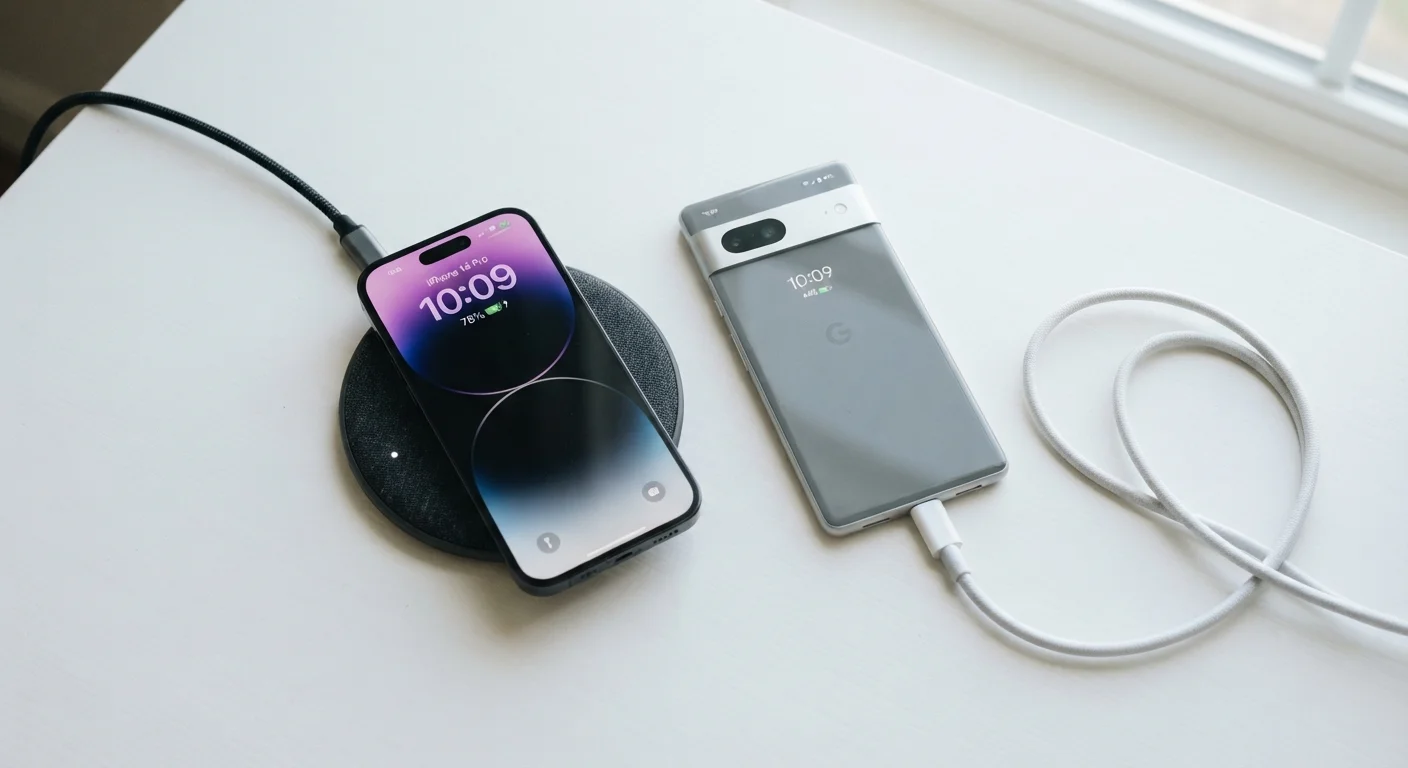
Wireless charging feels like magic, but there are real trade-offs. Here's an honest look at how both methods work and when each makes sense.
Option A
Wired charging
The straightforward, fast method that has worked for decades.
Best for: Anyone who wants the fastest possible charge or needs to top up quickly before heading out.
Option B
Wireless charging
The cable-free option built into most modern smartphones.
Best for: Anyone who wants to drop a phone on a pad without thinking about plugging anything in.
Key takeaways
- Wired charging is generally faster than wireless charging at comparable power levels.
- Wireless charging converts some energy to heat, which can slightly stress a battery over time.
- Wireless charging requires physical contact with a pad, so "wireless" means no cable, not no surface.
- Both methods are safe for everyday use when you use equipment that meets safety standards.
- Your charging habits and phone use patterns matter more than the method itself.
How each method actually moves power into your battery
Wired charging runs electricity directly from a power adapter through a cable into your phone's charging port. The phone's internal circuit (called a charge controller) manages how much current flows and adjusts it as the battery fills. The path is short and direct, so very little energy is lost along the way.
Wireless charging uses a process called inductive coupling. The charging pad contains a coil of wire that generates a magnetic field when plugged in. Your phone has its own coil inside the back cover. When the two coils are close enough, that magnetic field induces a current in the phone's coil, which the phone then converts into the DC power its battery needs. The extra conversion steps are why wireless charging is less efficient. Some energy becomes heat rather than stored charge.
The most common wireless standard in consumer phones is Qi (pronounced "chee"), maintained by the Wireless Power Consortium. A second standard, MagSafe, is Apple's proprietary implementation that uses magnets to align the coils precisely, which helps efficiency slightly compared to misaligned Qi charging.
What "watts" means in plain terms
Wattage is the rate at which power is delivered. A 20-watt charger fills your battery roughly four times faster than a 5-watt charger, all else equal. The wattage your phone actually accepts is limited by the phone's own hardware, so using a high-watt adapter does not help if the phone cannot use it. Check your phone manufacturer's specs to know its maximum supported wattage for both wired and wireless charging.
Speed and heat: the practical gap
Standard wired chargers for phones typically deliver anywhere from 5 watts to over 100 watts depending on the adapter and cable. Most wireless chargers for everyday use land between 5 and 15 watts, though some phones and pads support higher speeds. At equivalent wattage, wired charging is faster because it loses less energy to heat.
Heat is the main concern with wireless charging. Lithium-ion batteries degrade faster when they run hot repeatedly. Wireless charging produces more heat than wired charging at the same power level, though modern phones include thermal management to slow charging if temperatures rise too much. For most people charging once a day, this difference in long-term battery wear is gradual and small, not immediate or dramatic.
Several common beliefs about charging (like needing to drain your battery before recharging) are not accurate. Both wired and wireless charging are safe to use at any battery level.
Compatibility and real-world convenience
| Criterion | Wired charging | Wireless charging |
|---|---|---|
| Typical speed | Faster at comparable wattage | Slower due to energy conversion loss |
| Heat generated | Less | More |
| Cable required | Yes | No cable, but needs a pad |
| Works while using phone | Yes | Difficult without lifting phone |
| Universal compatibility | Depends on port type | Requires built-in coil in phone |
| Travel convenience | Compact cable | Pad plus power brick |
Wireless charging only works if your phone has the hardware for it. Many mid-range and budget Android phones do not include wireless charging coils. iPhones have supported Qi wireless charging since the iPhone 8. Cases also matter: very thick cases or cases with metal components can block or reduce the magnetic field, slowing or stopping wireless charging entirely.
On the convenience side, wireless pads are genuinely useful at fixed spots like a desk or bedside table. You set the phone down and it charges. The limitation is that you cannot easily use your phone while it sits flat on a pad without interrupting the charge. With a wired connection, you can pick up and use the phone while it charges without losing anything.
If you are curious about how other wireless technologies in your home interact, interference from nearby devices is worth understanding, though wireless charging and Bluetooth operate on different frequencies and do not meaningfully disrupt each other.
The content on this site is for informational purposes only and is not a substitute for professional advice. Always consult a qualified professional for guidance specific to your situation.