
Cat Training Decoded: What Works, What Doesn't, and Why

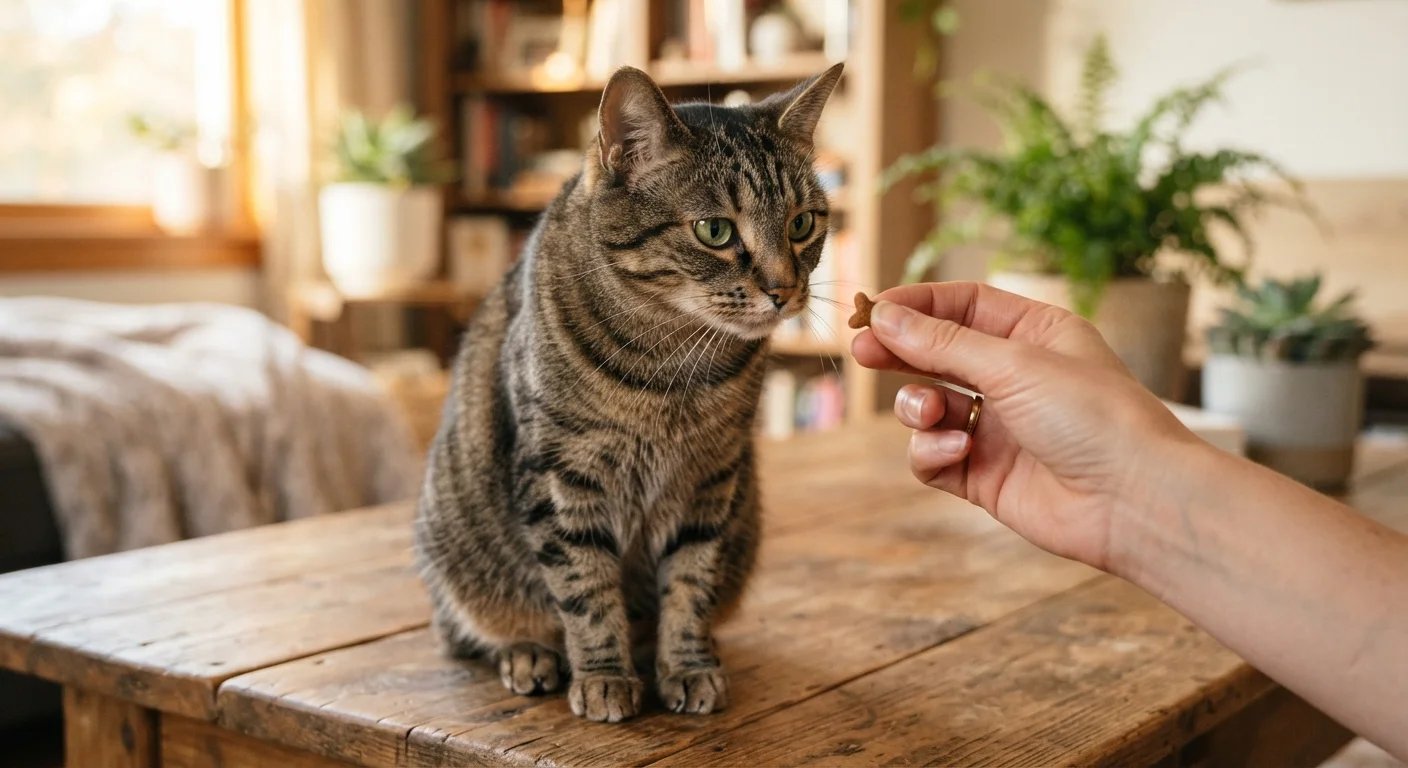
Cats can be trained, but they respond differently than dogs. Discover evidence-backed approaches that align with feline motivation and communication.
Key takeaways
- Cats learn through operant conditioning, meaning consequences shape their future behavior.
- Positive reinforcement with food or play is the most reliable training method for cats.
- Punishment-based approaches cause stress and damage the human-cat relationship.
- Sessions should be short, two to three minutes, to match a cat's natural attention span.
- Clicker training gives cats a clear, consistent signal that a reward is coming.
- Body language tells you whether your cat is engaged or has reached its limit for the session.
How cats actually learn
Cats learn through the same core mechanism as most animals: operant conditioning. When a behavior produces a good outcome, the cat is more likely to repeat it. When a behavior produces nothing useful, it fades. This is not unique to dogs or humans; it applies equally to cats, which is why the popular idea that cats are untrainable is simply wrong.
What is different about cats is their motivation structure. Dogs have been bred over thousands of years to find human approval rewarding on its own. Cats have not. For a cat, a reward needs to be intrinsically valuable, most often food, but sometimes play or physical contact depending on the individual animal. Praise alone rarely moves the needle.
Cats are also more sensitive to environmental context than dogs. A dog may work through mild discomfort or distraction to earn a reward. A cat that feels unsafe, overstimulated, or simply not hungry will disengage entirely. Understanding this distinction changes how you approach every session. For a broader look at feline health factors that influence behavior and appetite, see the Pet Health Basics hub.
What training methods work for cats
Positive reinforcement is the foundation of effective cat training. You mark a desired behavior the instant it happens and immediately follow it with something the cat values. The marking can be a clicker, a short verbal cue like "yes", or a tongue click. The reward is typically a small, soft food treat, delivered within one to two seconds of the mark.
The clicker has a practical advantage: it produces a sound that is fast, consistent, and distinct from anything else in the environment. This precision matters because cats read timing very literally. A reward that arrives three seconds late gets associated with whatever the cat was doing at that moment, not the behavior you intended to reinforce.
Use a treat the cat does not get at any other time. The rarity of the reward increases how hard the cat works to earn it during training sessions.
Reward value is relative to what else is available. A treat the cat can access freely throughout the day loses its training currency quickly.
Keep your marker sound identical every session. Even a slight change in tone or timing can blur the association the cat has built between the sound and the incoming reward.
Cats process the marker as a precise signal. Variability in the marker introduces ambiguity that slows learning, particularly in early stages.
Target training is a reliable starting point for most cats. You present a small object, often a stick with a ball at the tip, and reward the cat for touching it with its nose or paw. Once the cat reliably touches the target, you can use it to guide the animal into positions or toward locations. Most of the practical behaviors covered later in this article build on a solid target-training foundation.
Play-based reinforcement works well for cats that are less food-motivated. A short burst of interactive play immediately after a correct behavior can function as a reward. The timing rules are the same: the play starts within seconds of the mark, not after a delay.
Common training mistakes and why they backfire
Physical correction and punishment-based methods consistently produce worse outcomes with cats than with other domestic animals. Spraying a cat with water, scruffing it outside a veterinary context, or using a loud noise to startle it may suppress a behavior in the moment, but it does not teach the cat what to do instead. The cat learns that the environment is unpredictable and that the human is a source of threat, which erodes trust and increases anxiety over time.
Avoid punishment-based techniques
Spraying water, loud startling noises, and physical corrections do not teach cats what to do differently. These methods increase stress and can make a cat fearful of its owner or the training environment. Cats trained with aversive methods often show more behavior problems over time, not fewer.
Luring without a clear marker is another frequent error. Many owners hold a treat near a cat's nose to guide it into a sit, then deliver the treat. Without a marker, the cat does not learn a clean association between the position and the reward. The behavior stays dependent on the treat being visible, which means it will not generalize or remain reliable when the treat is out of sight.
Session length is also a common stumbling block. A 15-minute session that feels productive to the owner is usually past the cat's engagement threshold after the first few minutes. Once the cat disengages, continuing does not produce learning; it only builds a negative association with the activity.
Practical behaviors you can teach
Several behaviors have direct practical value and are accessible for most adult cats:
- Sit: Hold a treat just above the cat's nose and move it slightly back over the head. Most cats will lower their haunches. Mark and reward at the lowest point.
- Come when called: Start with the cat nearby. Say the cat's name or a consistent cue, immediately place a treat on the floor in front of it, and repeat. Gradually increase distance over many sessions.
- Carrier acceptance: Leave the carrier open as a resting space with bedding inside. Feed meals near it, then inside it, before ever closing the door. This reduces the stress associated with veterinary visits significantly.
- Stationing: Train the cat to go to a specific mat or perch on cue. This is useful for managing multi-pet households and for keeping the cat calm during activities like grooming.
Litter box issues sometimes intersect with training, though they more often reflect environmental or medical causes. If your cat has stopped using its box, behavioral causes of litter box avoidance covers how to identify and address those triggers.
Reading your cat during training
A cat that is engaged in a training session will have forward-facing ears, a loose body posture, and will orient toward you or the target consistently. A cat that is done will look away, groom itself, flick its tail, or simply walk off. Both responses give you information. Stopping when the cat is still engaged leaves the session on a positive note. Pushing past disengagement does not accelerate learning.
Stress signals during training include flattened ears, a low crouched posture, dilated pupils, and rapid tail movement. If you see these, end the session immediately and revisit the environment: the space may be too noisy, the treats may not be high-value enough, or the cat may need a day off. For a full breakdown of feline body language in different contexts, the guide to reading pet body language provides a detailed reference.
Building a consistent routine
Cats learn faster from short, frequent sessions than from long, infrequent ones. Two to three minutes, once or twice a day, is more productive than a single 20-minute block. Scheduling sessions before a meal takes advantage of the cat's natural hunger, which increases motivation without requiring artificially withheld food.
Consistency in cues matters as much as session frequency. If the verbal cue for sit changes between sessions, the cat has to relearn the association each time. Choose one word or gesture per behavior and use it every time. Everyone in the household should use the same cues, because cats do not automatically generalize across different voices or hand signals. Structuring a training routine that accounts for these variables makes a measurable difference in how quickly behavior becomes reliable.
Progress is rarely linear. A behavior that seemed solid can fall apart after a change in environment, a health issue, or even a change in the cat's routine. If a previously learned behavior degrades, go back to basics: shorter distance, simpler version of the behavior, higher-value reward. Regression is not failure; it is information about where the cat's current threshold sits.
This article is for informational purposes only. For concerns about your cat's health or behavior, consult a licensed veterinarian or certified animal behaviorist.
The content on this site is for informational purposes only and is not a substitute for professional advice. Always consult a qualified professional for guidance specific to your situation.