
Understanding Wheel Alignment and Why It Affects More Than Your Steering

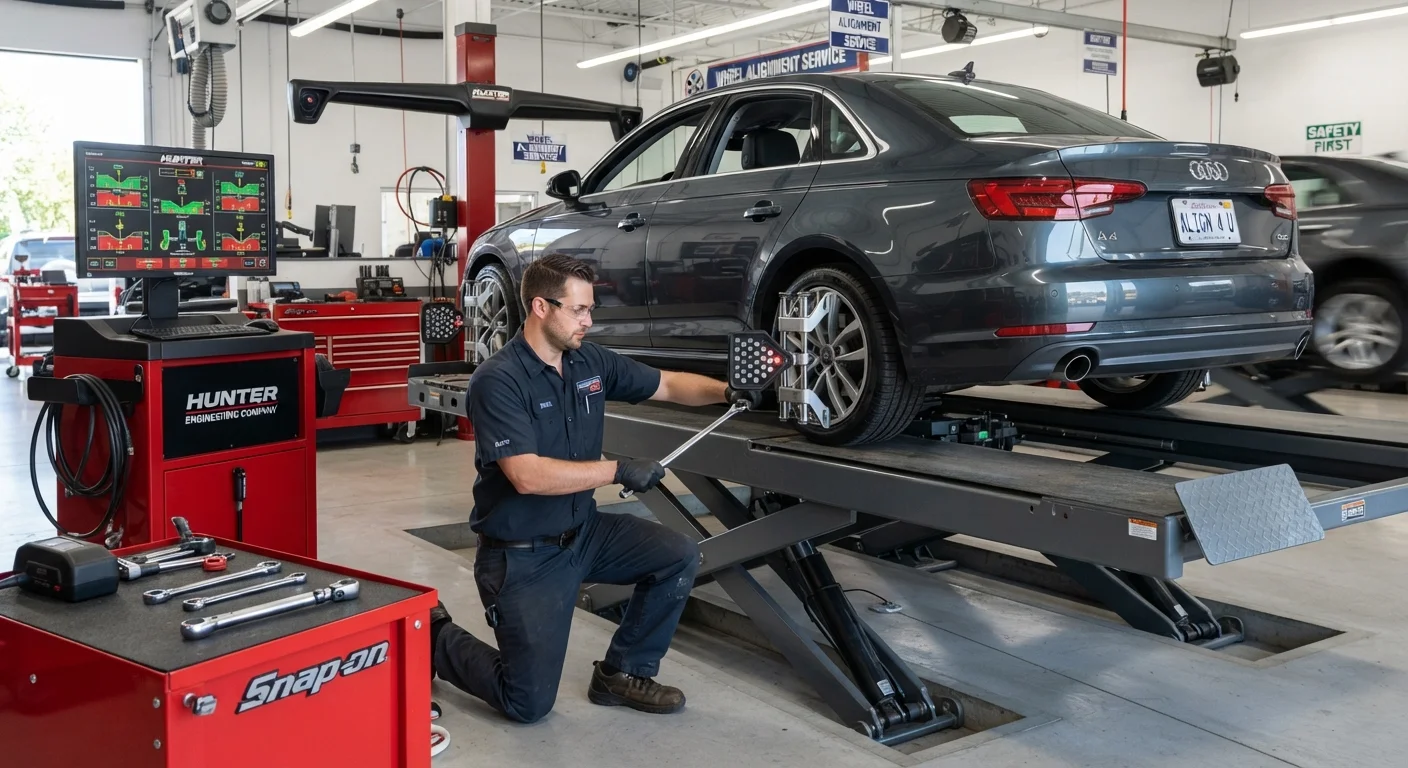
Misaligned wheels wear tyres unevenly and stress suspension components. Understand what alignment involves and when it needs professional correction.
Key takeaways
- Misaligned wheels cause uneven tyre wear, which shortens tyre life and increases road-safety risk.
- Alignment shifts gradually over time and can change suddenly after hitting a pothole or curb.
- Pulling to one side, a vibrating steering wheel, and off-center steering are common symptoms.
- Alignment correction requires precision measuring equipment and should be done by a qualified mechanic.
- Checking alignment after suspension or steering repairs, and at regular intervals, helps catch problems early.
What wheel alignment actually measures
Your vehicle's suspension holds each wheel at precise angles relative to the road and to the other wheels. Those angles are engineered for a specific balance of straight-line stability, cornering response, and tyre longevity. Alignment service measures whether those angles still match the manufacturer's specifications and adjusts them when they do not.
The three angles checked on most vehicles are camber, toe, and caster. Camber describes the vertical tilt of the wheel when viewed from the front: a wheel leaning outward at the top has positive camber; leaning inward has negative camber. Toe describes whether the front edges of a pair of tyres point toward each other (toe-in) or away from each other (toe-out). Caster describes the tilt of the steering axis when viewed from the side and affects steering feel and self-centering behavior.
These measurements are interdependent. A change in one angle can affect how another angle performs in real driving conditions, which is why a full four-wheel alignment check is more thorough than adjusting a single angle in isolation.
How alignment problems develop
Alignment does not stay fixed forever. Normal road use causes gradual drift as suspension bushings and ball joints wear and settle. Sudden impacts accelerate that process. Hitting a pothole at speed, striking a curb while parking, or going over a speed bump too fast can knock suspension components out of position immediately.
Worn suspension components compound the problem: if a control arm bushing is soft or a ball joint is loose, the wheel position shifts dynamically under load, making it impossible to hold a stable alignment even after adjustment. This is why a mechanic should inspect suspension condition before performing an alignment correction.
Check alignment when fitting new tyres
New tyres fitted to a vehicle with existing misalignment begin wearing incorrectly from the first mile. Scheduling an alignment check at the same appointment as a tyre installation is a straightforward way to protect the investment in new rubber and avoid repeating the problem.
Tyre changes are another trigger point. Fitting new tyres without checking alignment means the new rubber begins wearing on an already-incorrect geometry. The cost of an alignment check at the time of tyre installation is low compared to the cost of premature tyre replacement.
Symptoms that suggest an alignment check is needed
Several driving behaviors point to possible misalignment. The vehicle pulling consistently to one side on a flat, straight road is the most familiar sign. A steering wheel that sits off-center when driving straight, or one that vibrates at highway speeds, also warrants investigation. Note that these symptoms can have other causes, so a professional diagnosis is necessary before attributing them to alignment alone.
Tyre wear patterns are a more objective indicator. Wear concentrated on one shoulder of a tyre suggests a camber problem. Feathering across the tread, where one side of each tread block wears more than the other, typically points to a toe issue. Inspecting tread depth and pressure regularly makes it easier to spot these patterns before they become severe.
What happens during a professional alignment service
A qualified mechanic places sensors or clamps on all four wheels and connects them to an alignment machine. The machine compares the live angle readings against the specification database for the vehicle's year, make, and model. The mechanic then adjusts the relevant components, which may include the tie rods (for toe), eccentric bolts on control arms (for camber), or strut mounts (for caster), until all measurements fall within tolerance.
Not every angle is adjustable on every vehicle. Some manufacturers design fixed camber into the suspension, meaning correction is only possible if a worn component is replaced. A mechanic should explain which adjustments are possible on your specific vehicle and what component replacement, if any, is needed first.
Tyre condition and road safety also depends on correct alignment being maintained after the service, so avoid large impacts and check tyre wear patterns between annual alignment inspections.
This article is for general informational purposes only. For diagnosis and repair of your specific vehicle, consult a qualified mechanic.
Frequently Asked Questions
The content on this site is for informational purposes only and is not a substitute for professional advice. Always consult a qualified professional for guidance specific to your situation.