
Using Roundabouts Correctly: Rules, Yield Logic, and Lane Choice

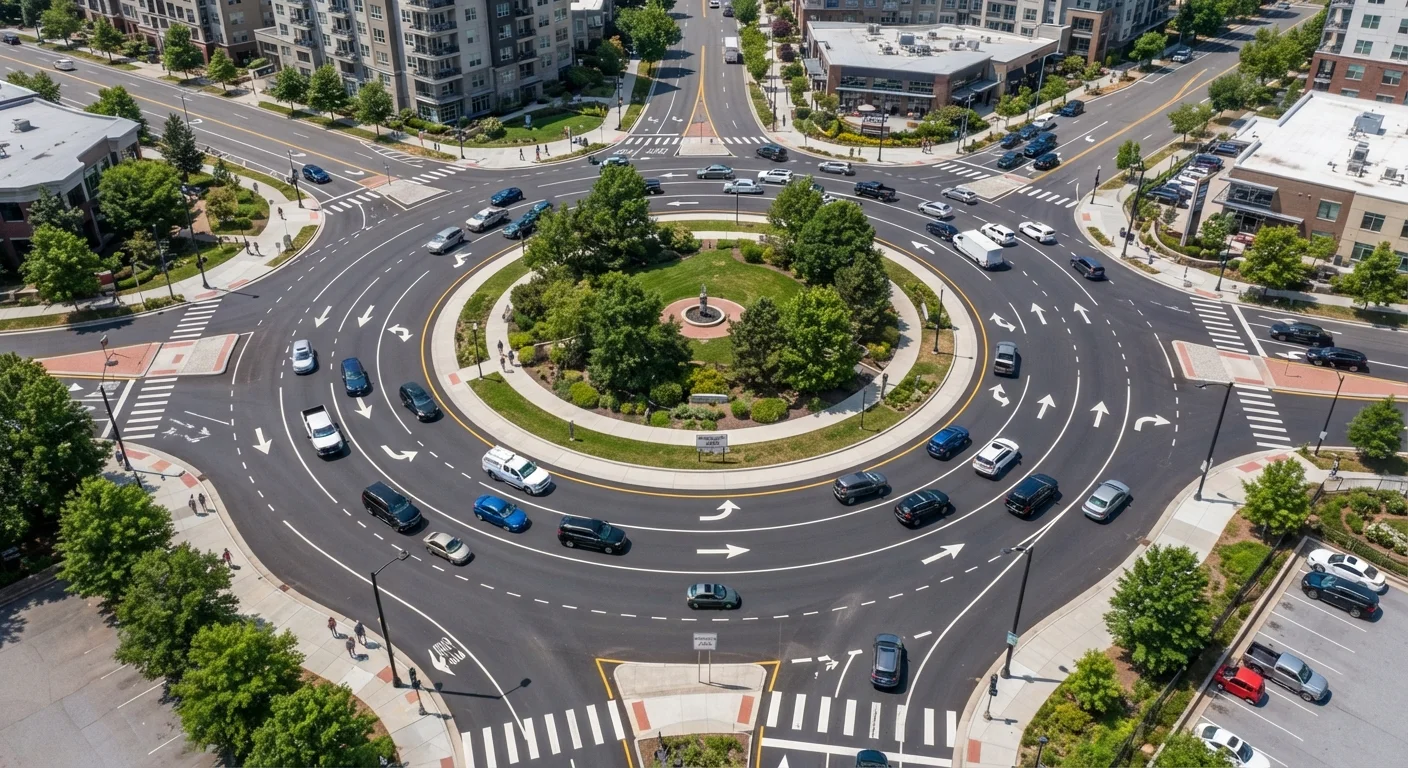
Roundabouts reduce serious collision rates but confuse many drivers. Walk through yield rules, lane selection, and how to exit without cutting across traffic.
Key takeaways
- Yield to circulating traffic before entering a roundabout, not after you are inside.
- Lane choice at entry determines which exits you can reach without crossing other lanes.
- Signal your exit intent so pedestrians and cyclists can anticipate your path.
- Multi-lane roundabouts require you to stay in your lane throughout the full circle.
- Stopping inside a roundabout blocks traffic; yield at the entry line, then commit.
Why roundabouts trip up experienced drivers
Roundabouts replace traditional signalized intersections with a continuous circular flow. Studies from the Insurance Institute for Highway Safety have found that converting stop-sign or signal-controlled intersections to roundabouts can reduce fatal and injury crashes substantially, largely because drivers travel slowly and collisions tend to be glancing rather than head-on or T-bone.
Despite that safety record, many drivers hesitate, stop in the wrong place, or drift across lane markings because the yield logic runs opposite to what signals train us to expect. At a red light you stop first and then go; at a roundabout you assess first and yield only if traffic is already in the circle. That mental switch is where most confusion begins.
See our guide to urban versus motorway driving demands for context on how low-speed, high-decision environments differ from open-road driving.
Equipment and knowledge you need before you start
What you will need
No special equipment is required. What matters is understanding the road markings at your specific roundabout before you enter. If the entry has multiple lanes, read the directional arrows painted on the pavement at the approach, not when you are already in the circle.
Step-by-step: navigating a roundabout
Slow down on the approach and read the signs
Reduce speed as you approach the yield line. Most US roundabouts post a recommended speed of 15 to 25 mph inside the circle. Scan the overhead signs and pavement arrows before the entry to confirm which lane serves your intended exit.
Yield to vehicles already in the circle
Stop or slow at the dashed yield line. Traffic already circulating inside the roundabout has the right of way. Wait for a gap that gives you time to enter and reach your exit at the posted advisory speed without forcing other drivers to brake.
Enter smoothly and hold your lane
Once a safe gap appears, enter at a steady speed. Do not accelerate sharply. In a multi-lane roundabout, stay within your chosen lane's boundaries throughout the arc. Avoid drifting toward the central island or toward the outer curb.
Signal before your exit
Activate your right turn signal as you pass the exit just before your intended one. This tells pedestrians at the crossing and drivers at the next entry point that you are about to leave the circle. Cancel the signal after you have exited.
Exit and yield to pedestrians
Steer smoothly onto the exit road. Slow for any pedestrian crossing set back from the circle and yield to anyone crossing or waiting. Accelerate to road speed only after clearing the crossing zone.
Hesitation is the most common source of conflict at roundabouts. Once you have yielded appropriately and a safe gap exists, commit to entering at a consistent speed. Drivers behind you are timing their own entry around your movement. Stopping inside the circle after entering is not a safe option and is prohibited in most states.
For a broader framework on reading traffic and reducing risk, see our overview of defensive driving principles.
Practice on low-traffic roundabouts first
If roundabouts feel unfamiliar, seek out a small single-lane example in a quiet area during off-peak hours. Repeating the entry-yield-exit sequence in low-pressure conditions builds the pattern recognition that makes busier roundabouts much less stressful. New drivers building broader road confidence can also benefit from the foundational habits covered in our highway driving guide for new licence holders.
Multi-lane roundabouts and common errors
A single-lane roundabout is relatively forgiving. Multi-lane versions demand precise lane discipline because drivers on the inside lane and outside lane are circling at the same time, and their paths cross at every exit.
The general rule in the US is: use the right lane if you are turning right or going straight to the next exit, and use the left (inner) lane if you are going halfway around or more. This varies by specific junction design, so always follow the pavement arrows at the approach.
The two errors that cause most near-misses in multi-lane roundabouts are drifting outward from the inner lane while circling (cutting across the outer lane at your exit) and entering the outer lane and then trying to continue past the first exit by crossing into the inner lane's path. Neither maneuver is safe. Stay in the lane you entered and exit from it.
Trucks and buses may legally occupy both lanes when their turning radius requires it. Give them extra space and do not try to pass alongside them in the circle.
If you miss your exit, continue around the circle and take it on the next pass. Reversing or stopping to reorient is dangerous and illegal.
Pedestrians, cyclists, and when to slow further
Roundabouts have designated pedestrian crossings on the approach and exit lanes, set back from the circle itself. Drivers exiting must yield to pedestrians waiting at or crossing those zebra crossings, even after successfully navigating the circle.
Cyclists may ride in the travel lane or use a separate path around the perimeter, depending on local infrastructure. When they are in the lane, treat them as you would any other vehicle and do not squeeze past inside the circle.
Wet or icy pavement raises the risk of skidding on the curved path. Reduce speed at the approach well before the yield line so you are not braking while already on the arc. For more on how road curvature affects vehicle control, see why drivers misjudge curves.
Aggressive behavior at roundabouts, particularly forcing entry without yielding or tailgating slow entries, is a common frustration trigger. Our article on understanding road rage explains how small friction moments escalate and how to step back from them.
The content on this site is for informational purposes only and is not a substitute for professional advice. Always consult a qualified professional for guidance specific to your situation.