
Why Drivers Underestimate Curves and What Happens Next

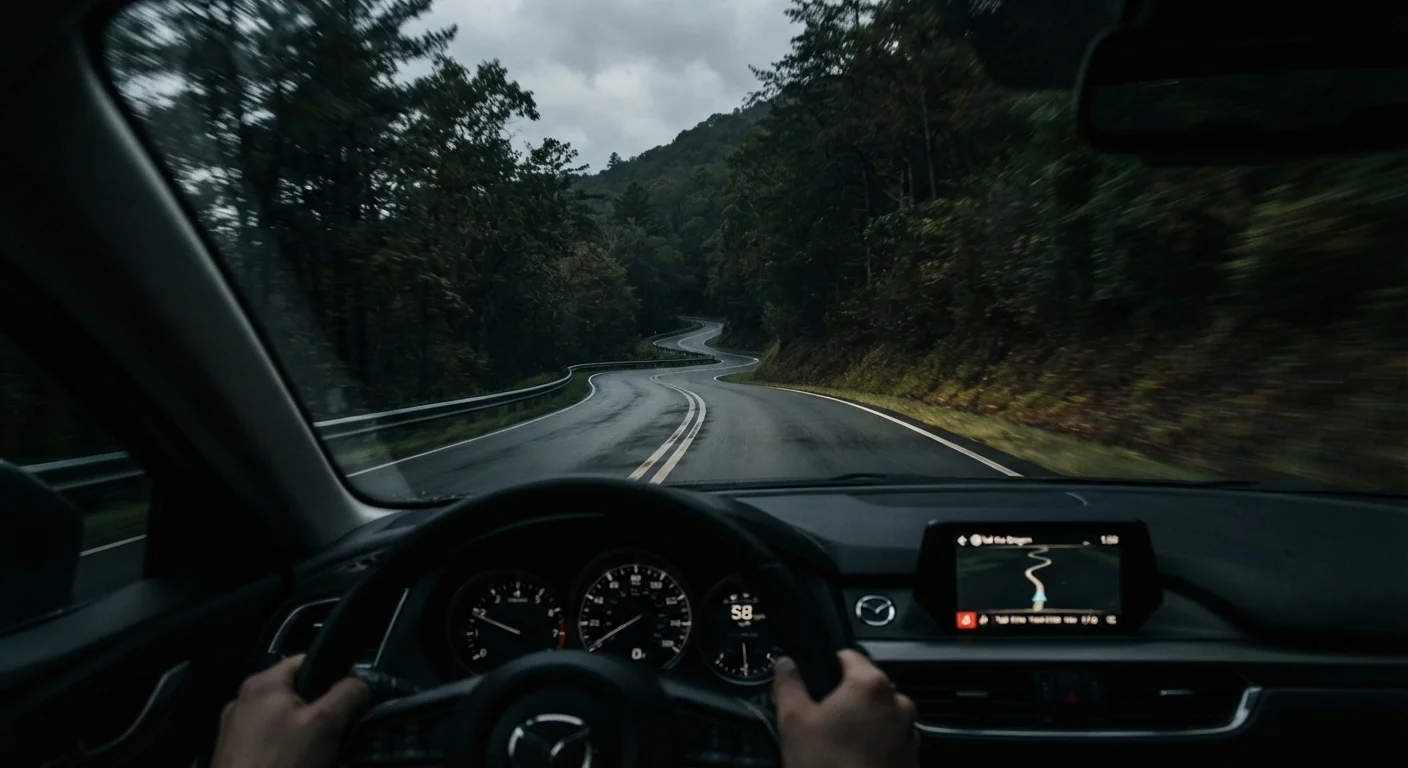
Entering a bend too fast is a predictable error rooted in visual perception and overconfidence. Understand the physics and the common misjudgements behind it.
Key takeaways
- Drivers routinely enter curves faster than the geometry allows because the full arc is not visible at the approach.
- Physics does not forgive late braking inside a curve. Centrifugal force and reduced tire grip compound quickly.
- Wet pavement, worn tires, and road camber can each cut safe cornering speed well below posted advisory speeds.
- The correct moment to reduce speed is before the curve begins, not during it.
- Overconfidence from familiar routes is a documented factor in single-vehicle run-off-road crashes.
Why the eye lies at curve entry
When a driver approaches a curve, the visible portion of the road appears to sweep gently before the full arc reveals itself. The brain uses that initial sight line to estimate how sharp the turn will be, and it almost always guesses too mild. This happens because the eye measures the angle at the point of approach, not the tightest point of the curve, which is usually hidden by vegetation, terrain, or the road's own geometry.
The result is a speed that feels appropriate at the 200-foot mark but becomes too fast by the time the driver reaches the apex. At that point, braking hard is no longer a clean solution. Braking shifts weight forward and reduces the rear tires' ability to maintain lateral grip, which is exactly the grip needed to hold a line through the turn.
Late braking in a curve is not a recovery
Applying strong brakes mid-corner transfers weight forward and collapses rear-tire lateral grip. On a rear-wheel-drive vehicle this can trigger oversteer; on a front-wheel-drive vehicle it often produces understeer that pushes the car wide. If you find yourself braking hard inside a curve, ease off gradually rather than releasing all at once, and do not turn the wheel further while braking hard.
Advisory speed signs posted on curves (the yellow diamond signs with a speed in miles per hour) reflect the geometry of that specific curve under dry conditions. They are not conservative suggestions. Exceeding them by even 10 mph meaningfully changes the forces the tires must manage.
Common mistakes that lead to curve-entry errors
Braking inside the curve rather than before it.
Why it happens: Drivers judge speed too late, only recognizing they are going fast once the curve tightens around them.
Trusting familiarity with a road as a reliable speed guide.
Why it happens: Repeated exposure to a route builds unconscious confidence, and drivers stop reading the road actively and start running on habit.
Ignoring advisory speed signs as overly cautious.
Why it happens: Many drivers assume official speed values include large safety buffers and that their own vehicle or skill level justifies higher entry speeds.
Looking only at the near edge of the curve rather than projecting ahead through it.
Why it happens: The natural instinct is to watch the road immediately ahead, which does not give the eye enough information to judge the full arc.
Underestimating the effect of wet or deteriorated pavement on cornering grip.
Why it happens: Drivers calibrate curve speeds on dry days and do not automatically adjust when conditions change.
Several of these mistakes compound each other. A driver who is mildly fatigued, traveling a familiar road, and running slightly late is simultaneously more overconfident, less attentive to road markings, and less likely to brake early. That combination is more dangerous than any single factor alone.
Understanding how roundabouts and other curved road features work can help build consistent curve-reading habits. See how yield logic and geometry interact in roundabouts for a related look at speed management in curved traffic environments.
What the physics actually does
Centripetal force (the inward force that keeps a car on a circular path) increases with the square of speed. Double your speed through a curve and the required grip quadruples. Tires have a finite friction budget, and that budget must cover both lateral cornering force and any braking or acceleration force applied at the same time.
~30%
Of fatal crashes that are single-vehicle events
According to the National Highway Traffic Safety Administration, a substantial share of fatal single-vehicle crashes involve roadway departures, many of which occur on curves.
4x
Cornering force increase when speed doubles
Because centripetal force scales with the square of speed, doubling entry speed through a curve requires four times the lateral grip from the tires.
Up to 50%
Reduction in wet-road tire adhesion
Tire and safety researchers consistently document that wet pavement can cut available friction by 30 to 50 percent compared to dry conditions, depending on tread depth and surface texture.
Road surface changes that budget sharply. Wet asphalt can reduce tire adhesion by 30 to 50 percent compared to dry conditions, depending on tire tread depth and pavement texture. A posted advisory speed of 35 mph on a dry curve may leave very little margin on a wet one.
Vehicle weight distribution also matters. A loaded SUV with a higher center of gravity reaches its rollover threshold at a lower lateral acceleration than a lower-profile sedan. The vehicle's handling in normal highway driving tells a driver almost nothing about its behavior at the limit of cornering grip.
Worn tires reduce the safety margin further, and the degradation is not linear: a tire at 2/32" of remaining tread depth handles wet cornering very differently from one at 6/32". Following distance math uses the same physics principle: grip and reaction time are consumed faster than drivers expect.
Building accurate curve habits
The practical correction is straightforward, though it requires deliberate practice to override the visual habit of braking late. Drivers should complete all speed reduction before the front wheels reach the curve entry. Once cornering has begun, gentle, steady throttle (or simply coasting) is safer than braking because it keeps weight balanced across all four tires.
On unfamiliar roads, slowing before any curve that is not fully visible is the sound default. The cost is a few extra seconds. On a mountain road at night, that habit is the difference between holding a line and a run-off-road departure.
Checking tire pressure and tread depth regularly is not a minor maintenance item when driving roads with curves. Underinflated tires flex more during cornering, which heats the rubber and reduces the effective contact patch. A qualified mechanic can assess whether tires are still within safe service limits if there is any doubt about condition.
The content on this site is for informational purposes only and is not a substitute for professional advice. Always consult a qualified professional for guidance specific to your situation.