
What Tailgating Actually Does to Your Risk Profile

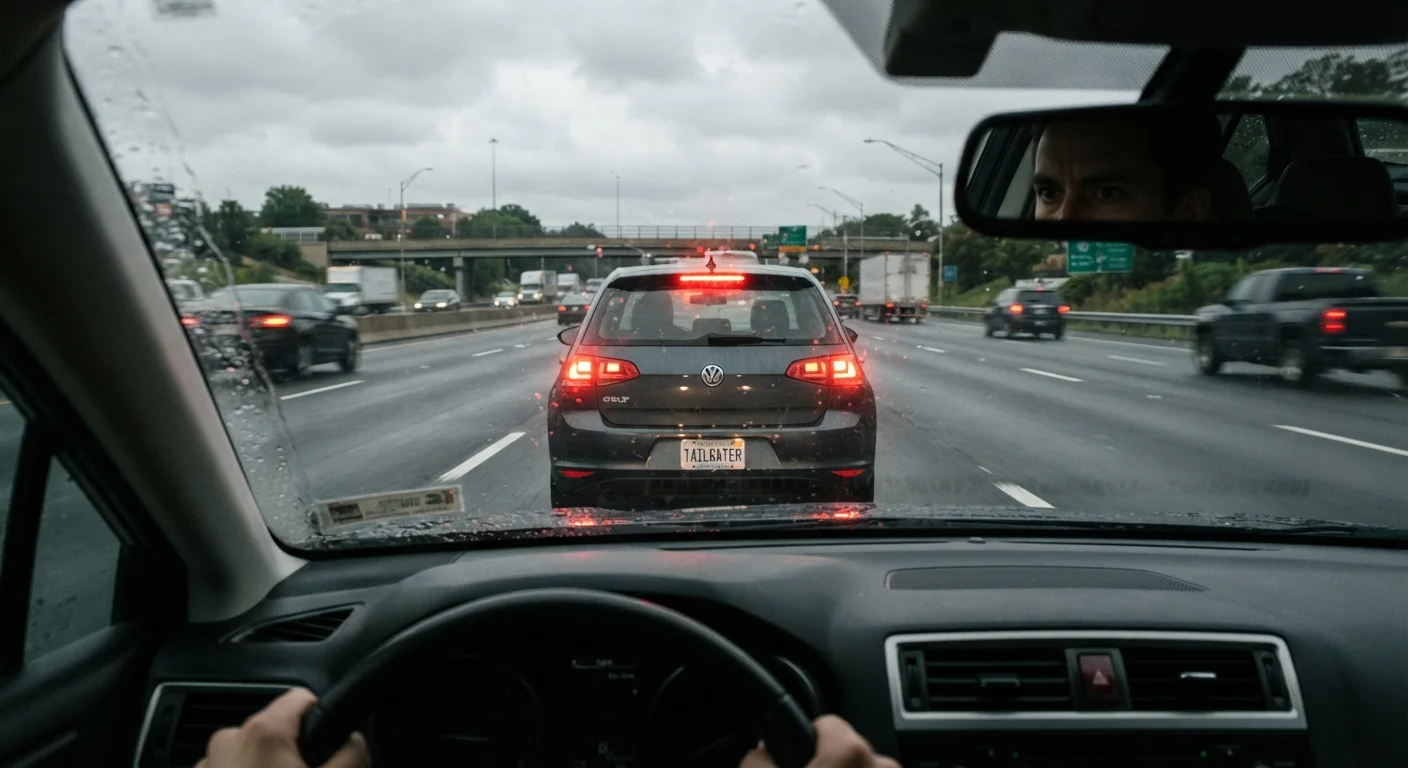
Following too closely is one of the most common crash contributors. Understand the gap-distance math and why two seconds is rarely enough.
Key takeaways
- Reaction time alone, at 60 mph, consumes roughly 132 feet before braking even begins.
- The two-second rule gives a minimum baseline, but rain, fatigue, and heavy vehicles each require more space.
- Rear-end crashes are among the most common collision types on U.S. roads, and following distance is a primary factor.
- Tailgating transfers almost all crash risk to the following driver, regardless of who caused the lead vehicle to stop.
- Increasing following distance costs almost no additional travel time on most trips.
The math that makes tailgating dangerous
At 60 mph, a vehicle travels 88 feet every second. A driver with an average perception-reaction time of 1.5 seconds covers about 132 feet before the brake pedal moves at all. Add braking distance on dry pavement and the total stopping distance can reach 270 feet or more. A driver following two car lengths behind at that speed has roughly 30 to 40 feet of buffer. The numbers do not balance.
This is why closing the gap does not simply reduce margin slightly. It eliminates the margin almost entirely. The lead vehicle's brake lights reach the following driver's eyes, the brain processes the signal, the foot moves, and the brakes engage. Each step consumes time and distance that the shrinking gap cannot absorb.
Speed compounds the problem in a non-linear way. Braking distance grows with the square of speed, not proportionally. A vehicle traveling at 70 mph needs roughly 55 percent more braking distance than the same vehicle at 55 mph, while the gap a tailgating driver leaves often stays the same physical length regardless of speed. The two-second rule and its limits covers how to apply gap timing accurately across conditions.
Where the risk actually falls
Rear-end collisions are consistently among the most frequent crash types reported by the National Highway Traffic Safety Administration. In the large majority of cases, the following vehicle is found to bear fault, because maintaining adequate space is the following driver's legal and practical responsibility.
This matters for risk profile in a concrete way. A driver who follows too closely is almost always the one absorbing consequences when the lead vehicle stops for any reason: a pedestrian, a light change, a road hazard, or a sudden mechanical problem. The lead driver's reason for stopping is largely irrelevant to the physics involved.
Pick a fixed marker, not a feeling
To measure following distance accurately, choose a stationary roadside object: a sign, an overpass, or a painted line. When the vehicle ahead passes it, begin counting seconds. If you reach the marker before you finish counting your target seconds, you are too close. Relying on visual estimation of car lengths is consistently less accurate, especially at speed.
Fatigue makes this worse. A tired driver's reaction time extends beyond the average 1.5-second estimate, which adds more feet to reaction distance before braking begins. Driver fatigue and impaired reaction time explains how tiredness changes the numbers in ways drivers rarely account for.
Aggressive following also tends to cluster with other risky behaviors. Drivers who tailgate frequently also report higher rates of hard braking, sudden lane changes, and elevated speed. The psychology behind aggressive driving describes how these patterns reinforce each other.
Conditions that change the calculation
Dry pavement at moderate speed is the best-case scenario. Every variable that departs from that baseline increases the stopping distance and shrinks the available margin further.
- Wet pavement can increase braking distance by 30 to 50 percent depending on tire condition, speed, and road surface.
- Ice or packed snow can multiply braking distance several times over, making gaps that feel large feel irrelevant within seconds.
- Larger or heavier vehicles, including trucks and SUVs, require more distance to stop than smaller passenger cars at the same speed.
- Tires with worn tread grip less effectively, increasing braking distance even on dry roads.
The two-second rule is a useful starting point, but it was designed for ideal conditions. Three seconds is a more practical target at highway speeds, and four or more seconds is appropriate on wet, icy, or gravel surfaces. Conditions, not signs, determine safe speed addresses why posted limits alone do not tell drivers when to slow down.
What a larger gap actually costs
Drivers who tailgate often do so with an implicit assumption that maintaining a short gap saves time or holds position in traffic. The time calculation does not support this. On a typical 30-mile highway commute, maintaining a three-second following distance instead of a one-second gap changes arrival time by a matter of seconds, not minutes. Merges and lane changes are, in most cases, the larger variables in commute time.
A larger gap does carry one practical trade-off: other drivers may merge into it. The appropriate response is to restore the gap by easing off the accelerator slightly, not to tighten back up. The space is functional, not territorial.
Drivers who habitually keep adequate following distance report that stop-and-go traffic becomes less stressful because small fluctuations in the lead vehicle's speed do not require hard braking responses. The gap absorbs minor variations and reduces the physical and cognitive load of dense traffic.
Frequently Asked Questions
The content on this site is for informational purposes only and is not a substitute for professional advice. Always consult a qualified professional for guidance specific to your situation.