
Speed Limits Are Not Speed Targets

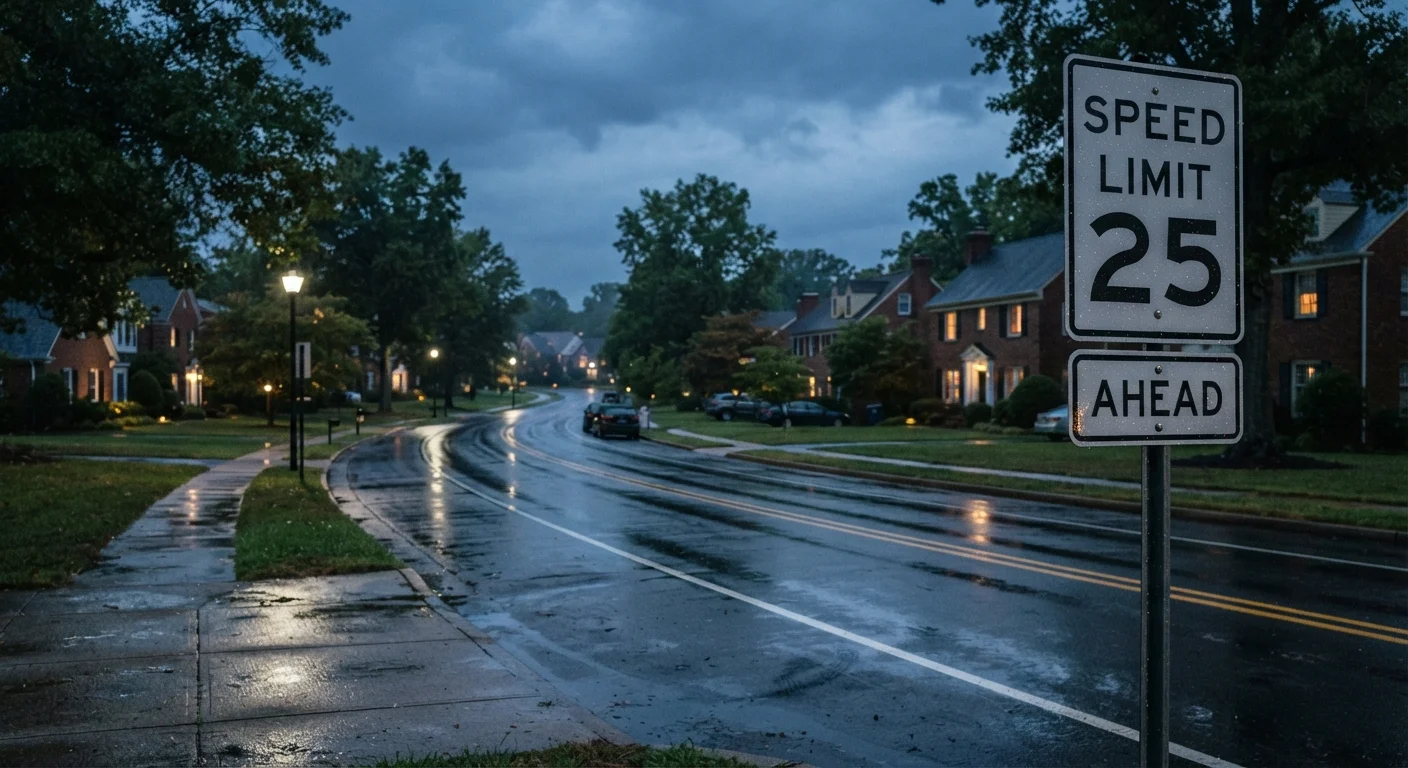
Many drivers treat posted limits as a floor rather than a ceiling. This explainer unpacks why conditions, not signs, should determine safe speed.
Key takeaways
- A posted speed limit is a ceiling, not a floor or a target.
- Road conditions, visibility, and traffic density all require speeds below the legal maximum.
- Reaction distance and stopping distance increase sharply as speed rises.
- Driving at the limit in poor conditions is legal but can still be negligent and dangerous.
- Speed choice is a judgment call the driver makes continuously, not once when they read the sign.
What a speed limit sign actually tells you
A speed limit sign communicates one specific piece of information: the maximum speed engineers and regulators deemed reasonable on that road under normal, favorable conditions. It does not represent the safest speed for rain, fog, ice, construction zones, heavy pedestrian traffic, or a curve that tightens unexpectedly. Those variables belong to the driver, not the sign.
Engineers typically set limits based on road geometry, surrounding land use, and observed traffic behavior under clear daytime conditions. When those conditions change, the number on the sign stays the same. The driver's judgment must fill the gap.
This distinction matters because a common driving pattern works in reverse: many drivers treat the posted number as an objective to reach. Sitting at exactly 65 mph on a foggy highway or a rain-soaked curve can feel responsible because the speedometer matches the sign. It is not.
Why speed and stopping distance are inseparable
Every speed decision is also a stopping-distance decision. Stopping a vehicle involves two phases: reaction distance (the distance traveled while the driver processes a hazard and moves their foot) and braking distance (the distance the vehicle travels after the brakes are applied). Both grow with speed, but braking distance grows faster because it scales with the square of velocity.
At 30 mph on dry pavement, total stopping distance for an average passenger car is roughly 75 feet. At 60 mph, it is not 150 feet; it is closer to 240 feet. That gap widens further on wet or icy roads, where braking distances can double or triple. Following distance rules are built on these same physics, and the same logic applies to speed choice.
When visibility drops to 200 feet in fog, a driver traveling at the posted 55 mph limit cannot stop before reaching something they cannot yet see. The speed that matches stopping ability to visible distance is the only safe choice in that situation, regardless of what the sign reads.
Adjust speed before you need to stop
Reacting to a hazard and then braking is always slower than anticipating a situation and slowing in advance. Scan the road ahead for intersections, pedestrians, merging lanes, and changing surfaces. Reducing speed before a potential hazard gives stopping distance its full value.
Conditions that require lower speeds
Several categories of conditions consistently require speeds below the legal maximum.
Weather: Rain reduces tire grip and lengthens stopping distances. Ice can reduce traction by a factor of four compared to dry pavement. Snow, wind, and fog each reduce either grip or visibility, sometimes both.
Visibility: Night driving, glare, sun angles, and curves all shorten the distance within which a driver can identify and respond to hazards. Curve entry speed is a common error rooted in this problem. When the visible road ahead shortens, so should speed.
Traffic density: In congested or unpredictable traffic, maintaining reaction time requires a gap that only a lower speed can provide. Following too closely compounds speed-related risk substantially.
Road type and surface: Gravel, uneven pavement, road debris, and temporary surfaces all reduce grip or introduce unpredictability that the posted limit does not account for.
Urban and highway roads present different versions of these challenges, but in both environments the principle holds: conditions set the safe ceiling, and the sign sets only the legal one.
Legal exposure when driving at the limit in poor conditions
Most US states include a basic speed law in their vehicle codes. These statutes hold that a driver must travel at a speed that is reasonable and prudent for existing conditions, independent of posted limits. A driver cited or sued after a crash who was traveling at the exact speed limit can still be found negligent if conditions clearly warranted less.
Insurance adjusters, investigators, and courts examine conditions at the time of a crash. Being at or under the posted limit is not a shield against liability when physical evidence shows the speed was unreasonable for the road at that moment.
For new drivers building highway habits, this distinction is worth understanding early. Highway driving fundamentals include speed judgment alongside merging and lane discipline, because all three require active assessment rather than passive rule-following.
The number on a sign tells a driver where the legal boundary sits. Deciding where to travel within that boundary, accounting for everything the sign cannot know, is the continuous work of driving.
Frequently Asked Questions
The content on this site is for informational purposes only and is not a substitute for professional advice. Always consult a qualified professional for guidance specific to your situation.