
Common Myths About Driving in the Rain

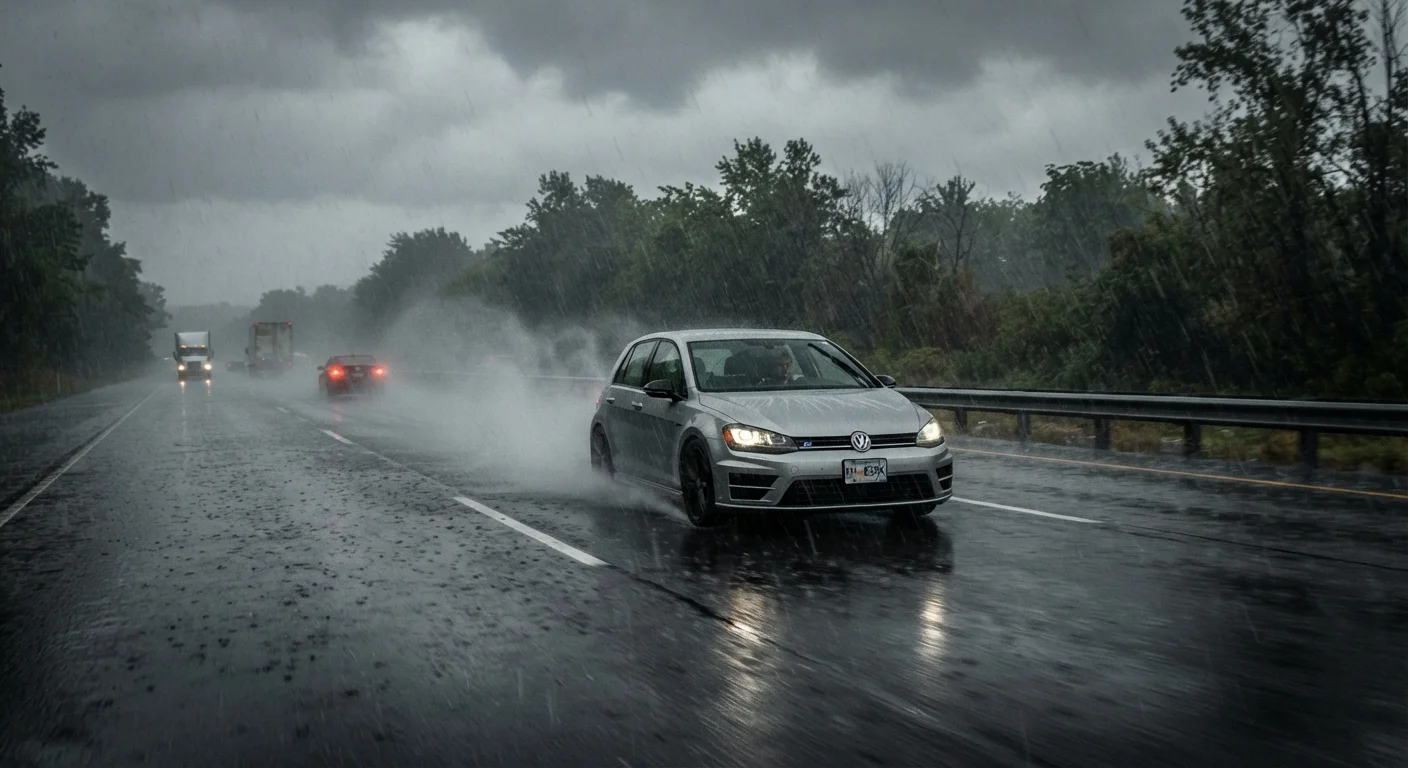
From traction beliefs to windscreen habits, several widely held assumptions about wet-weather driving are either incomplete or flat-out wrong.
Key takeaways
- AWD improves traction when accelerating but does not shorten stopping distances on wet roads.
- Hydroplaning can occur at speeds as low as 35 mph on standing water with worn tires.
- Turning your headlights on in rain is required by law in most U.S. states, regardless of visibility.
- Cruise control on wet roads can delay your ability to respond to a loss of traction.
- Properly inflated tires channel water away more effectively, reducing hydroplaning risk.
Why rain myths are worth correcting
Rain is one of the most common hazardous driving conditions in the United States. The Federal Highway Administration reports that wet pavement accounts for a large share of weather-related crashes each year. Yet a number of widely held beliefs about wet-weather driving are incomplete or incorrect, and acting on them can increase risk rather than reduce it.
The myths below come up often in driver conversations, online forums, and even informal advice passed between friends. Correcting them is not about alarm; it is about giving drivers an accurate picture of how their vehicles behave when the road is wet. For a broader view of how rain compares to other weather hazards, see driving in rain, snow, and fog.
Myth
AWD means you can drive normally in the rain because all four wheels are pulling.
Fact
AWD helps a vehicle accelerate and maintain forward motion on slippery surfaces, but it does not improve braking or cornering grip.
All-wheel drive distributes engine power to all four wheels, which reduces wheelspin when you press the accelerator. That benefit ends the moment you need to slow down or change direction. Stopping distance on wet pavement depends on the tires and braking system, not on how power is delivered. A driver in an AWD vehicle who enters a curve too fast, or brakes late, faces the same loss of grip as anyone else. The false confidence AWD sometimes creates can lead to following distances that are too short and corner speeds that are too high.
Myth
Hydroplaning only happens at highway speeds, so city driving in the rain is safe.
Fact
Hydroplaning can begin at speeds around 35 mph, particularly with worn tires or standing water on the road.
Hydroplaning occurs when a tire cannot displace water fast enough and rides up onto a film of water rather than maintaining contact with the pavement. The speed at which this happens depends on tire tread depth, tire pressure, water depth, and road surface. A tire with shallow tread loses its ability to channel water efficiently at relatively modest speeds. City streets with poor drainage can accumulate enough standing water after moderate rain to trigger hydroplaning well below what most drivers think of as a dangerous speed.
Myth
You only need headlights in rain when visibility is very low.
Fact
Most U.S. states require headlights whenever windshield wipers are in use, regardless of how much you personally can see.
The purpose of headlights in rain is not only for the driver to see ahead; it is also for other vehicles, cyclists, and pedestrians to see you. A car without its lights on in grey, rainy conditions can be surprisingly hard to spot against wet pavement and overcast backgrounds. Beyond the legal requirement, running lights and low-beam headlights in rain cost nothing and reduce your risk of being struck. Check the specific statute in your state, as laws vary, but the general practice of turning headlights on whenever rain begins is sound in all conditions.
Myth
Cruise control is fine in light rain because the road is only a little slippery.
Fact
Cruise control in wet conditions can delay your reaction to traction loss and, in some systems, make recovery harder.
When a tire loses grip on wet pavement, the right response is usually to ease off the accelerator gently. Cruise control keeps throttle applied to maintain your set speed, which works against that response. If the system detects wheelspin and applies throttle to compensate, it can worsen a slide. Even in light rain, road conditions can change quickly as you pass through puddles, oil patches near intersections, or sections of road with different drainage. Disabling cruise control when rain begins is a simple habit that keeps throttle management in your hands.
Myth
Braking hard is the fastest way to stop in the rain.
Fact
Threshold braking, or allowing the antilock brake system to work as designed, stops a vehicle more reliably on wet pavement than a sudden hard stomp.
On a dry road, an experienced driver applying near-maximum brake pressure can stop quickly. On wet pavement, locking a wheel causes it to slide rather than roll, which reduces braking force and removes steering control. Antilock brake systems (ABS) modulate brake pressure automatically to keep wheels rolling at the edge of traction. The correct technique in a vehicle with ABS is to press the brake pedal firmly and hold it, letting the system do its job. The pulsing sensation you may feel through the pedal is normal and means ABS is active. Pumping the brakes in an ABS-equipped vehicle interrupts the system and lengthens stopping distance.
Myth
New tires handle rain better than older tires regardless of inflation.
Fact
An underinflated new tire can perform worse on wet roads than a properly inflated tire with moderate tread.
Tire pressure affects the shape of the contact patch and the efficiency with which tread grooves channel water. An underinflated tire deforms and spreads, which can close up the grooves that move water away from the contact area. Maintaining the pressure specified by your vehicle manufacturer, found on the sticker inside the driver's door jamb, is part of wet-weather preparedness. Tread depth still matters, but inflation is a factor that drivers often overlook when they focus only on tread wear.
Habits that matter more than you might think
Several of the myths above share a common thread: drivers overestimate how much a single vehicle feature protects them. AWD, antilock brakes, and traction control all help, but none of them override the physics of a tire trying to grip a film of water.
Two habits have a direct effect on wet-weather outcomes. First, tire maintenance matters more than most drivers realize. Tread depth and proper inflation affect how efficiently a tire channels water away from the contact patch. Wiper blades and tire condition are among the most commonly skipped checks before wet-weather trips.
Second, the fluid systems in your car affect visibility as much as any driving technique. A low washer reservoir or a degraded wiper blade can compromise your sightlines within seconds of the rain picking up. Checking your windscreen washer fluid and other fluids takes only a few minutes and removes one variable from an already demanding situation.
Night rain combines the hazards covered here with the separate visibility problems that come with darkness. Night driving demands its own adjustments, and wet pavement at night is one of the more consistently underestimated conditions a driver will encounter.
This article is for general informational purposes only. Always follow applicable traffic laws and consult a qualified mechanic for vehicle-specific maintenance questions.
The content on this site is for informational purposes only and is not a substitute for professional advice. Always consult a qualified professional for guidance specific to your situation.