
Why You Keep Overpacking (and the Mental Shift That Fixes It)

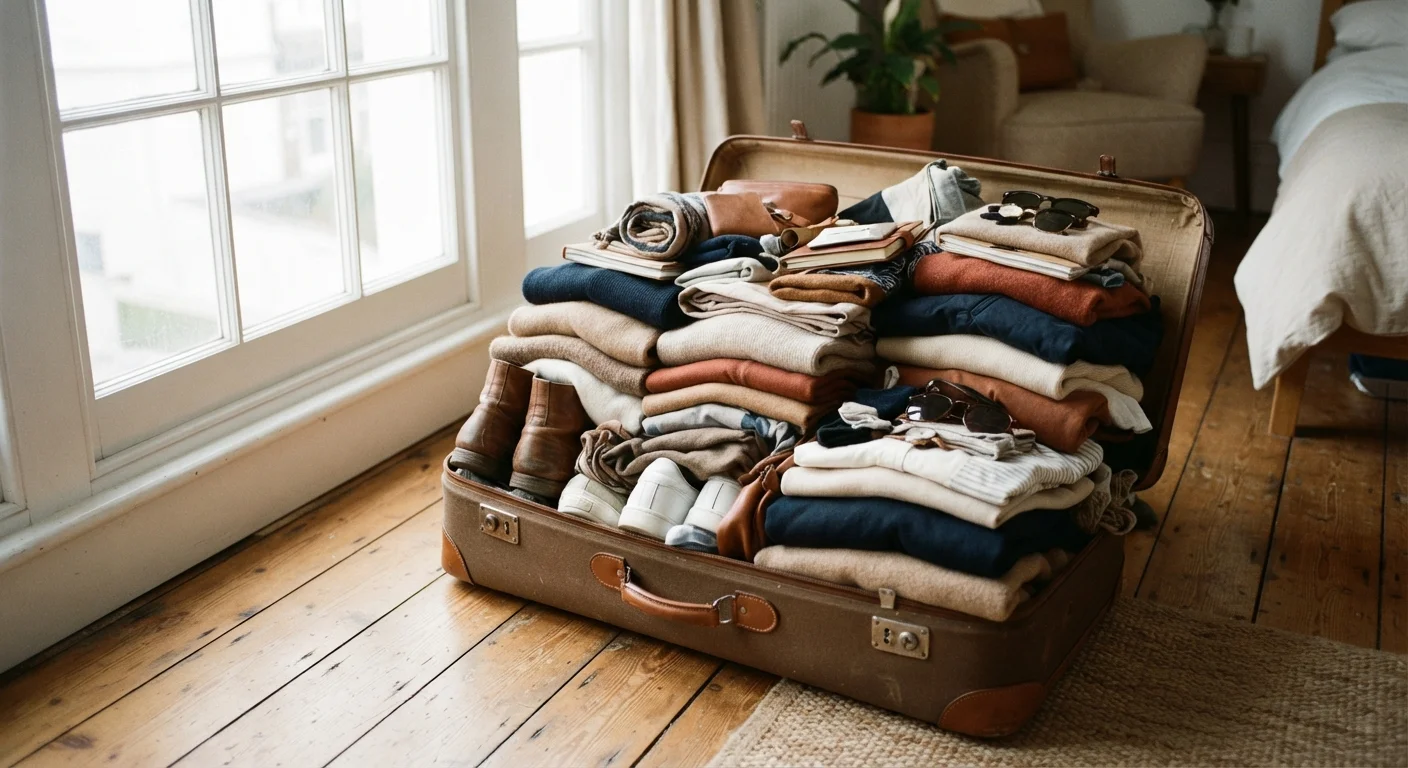
Overpacking is rarely about clothes. Explore the psychology behind packing too much and practical reframing strategies that actually stick.
Key takeaways
- Overpacking is usually driven by anxiety and worst-case thinking, not genuine need.
- Packing decisions made under stress tend to multiply items rather than narrow them.
- Shifting from 'what if I need it' to 'what will I actually use' consistently reduces bag weight.
- Most items packed 'just in case' can be purchased or improvised at the destination.
- A written packing list created days before departure reduces last-minute panic additions.
The real reason your bag is always too heavy
Overpacking is rarely a logistics problem. Most travelers who consistently bring too much are not confused about how much a suitcase holds. They are responding to anxiety about the unknown.
Before a trip, the mind tends to scan for everything that could go wrong: a spill, a cold snap, a formal dinner, a beach day that wasn't planned. Each scenario feels plausible, so each triggers an addition to the bag. The result is a suitcase built for six trips at once instead of one.
This pattern is worth understanding because the fix isn't a better packing list. It's a change in how you frame the decision itself. If you've ever stood at a full bag and still felt you were forgetting something, that feeling is the problem, not the bag. See also how packing myths reinforce this behavior, particularly the belief that more options mean more security.
Packing for every possible scenario rather than the actual itinerary.
Why it happens: Uncertainty about a trip makes worst-case scenarios feel equally likely as likely ones, so the brain treats each as worth preparing for.
Adding items the night before departure because of last-minute anxiety.
Why it happens: Pre-travel stress peaks close to departure, and adding items feels like taking control of uncertainty, even when the items aren't needed.
Bringing multiples of items you use once a day at home.
Why it happens: Travelers apply home logic to travel, forgetting that laundry, washing, and re-wearing are all realistic options on the road.
Treating 'just in case' as a valid reason to pack any item.
Why it happens: The phrase bypasses evaluation entirely, making it easy to justify unlimited additions without scrutiny.
Assuming items bought or found abroad will be inferior or unavailable.
Why it happens: Unfamiliarity with a destination leads to assuming it lacks normal infrastructure, which isn't accurate for most popular travel destinations.
The mental shift that actually changes packing behavior
The single most useful reframe is moving from possibility thinking to probability thinking. Instead of asking "could I need this?", ask "on this specific trip, will I realistically use this?" The first question has almost no filter. The second one does.
Pairing that question with a concrete scenario helps. If you're packing a fourth pair of shoes, name the day and occasion when you will wear them. If you cannot picture it, the shoes stay home.
Last-minute additions rarely help
Items added to a bag in the final hour before departure are the ones most likely to go unused. They are chosen under stress, not evaluation. If something wasn't on your original list and you're adding it at midnight before an early flight, it probably doesn't belong in the bag.
A second shift involves trusting the destination. Pharmacies, grocery stores, and clothing shops exist in most places travelers go. A forgotten item is usually a minor inconvenience, not a crisis. Mapping out what is genuinely unavailable at your destination (prescription medication, highly specialized gear) is worth doing. Everything else likely has a local substitute.
For a structured approach to putting these principles into practice, the carry-on-only packing framework walks through the capsule wardrobe method and bag selection in detail.
How to build better packing habits going forward
Habit change in packing works the same way it does in other areas of life: the decision environment matters more than willpower in the moment. A few structural changes make the anxious, last-minute pile-on less likely.
Write your packing list at least three days before departure, then close it. Add nothing on packing day unless it is genuinely critical. This separates the planning phase from the anxiety phase, which tends to peak the night before travel.
After each trip, note what you never touched. One honest review of an unused item tends to be more convincing than any general advice about packing light. Over two or three trips, a personal record of never-used items becomes a reliable filter. If you're newer to travel, the introduction to packing and gear covers the foundational concepts that make these habits easier to build from the start.
For travelers who want a realistic picture of what each approach costs and gains, packing light vs. packing everything breaks down the genuine trade-offs without defaulting to either extreme.
The content on this site is for informational purposes only and is not a substitute for professional advice. Always consult a qualified professional for guidance specific to your situation.