
Carry-On Only: A Complete Framework for Packing Any Trip in One Bag

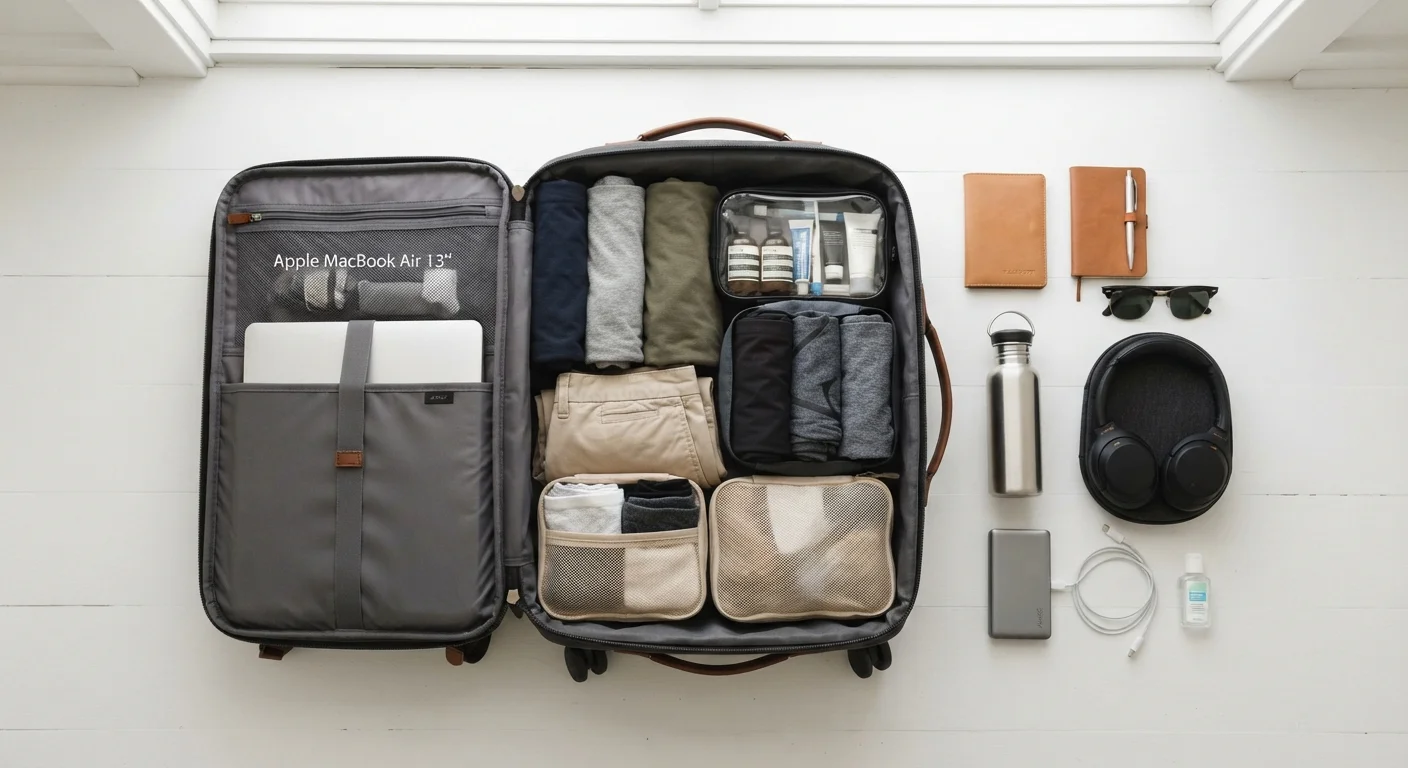
Learn the core principles behind carry-on-only travel, from the capsule wardrobe method to choosing the right bag dimensions.
Key takeaways
- Most airline carry-on size limits fall between 40 and 45 liters; verify your carrier before buying a bag.
- A clothing system built on neutral colors and versatile pieces reduces items without limiting outfits.
- Liquids in carry-on bags must follow TSA 3-1-1 rules: containers no larger than 3.4 oz, in one quart-sized bag.
- Electronics are the easiest category to over-pack; audit each item against actual usage on the trip.
- Rolling clothes instead of folding compresses volume and reduces wrinkles for most fabrics.
Why carry-on only works for most trips
Checked baggage fees, wait times at carousels, and the risk of lost luggage are concrete costs most travelers accept without questioning. Carry-on-only travel removes all three. It also compresses the decision space at the start of a trip: one bag means one thing to track, load, and move through every transit point.
The concern most people raise is that a single small bag cannot hold enough. In practice, the limiting factor is rarely the bag's volume. It is the absence of a system for choosing what goes in. Most travelers pack too many items in the same category, particularly clothing, while the bag itself has room for everything a well-considered list requires.
This framework addresses the common myths about packing light by organizing the packing decision into distinct categories and applying a clear rule to each one. If you are new to travel planning entirely, the introduction to packing and gear covers foundational concepts before you return here.
Bag dimensions and airline rules
Carry-on size limits vary by airline and are not standardized globally. In the United States, most major carriers allow a bag up to 22 x 14 x 9 inches (roughly 45 liters), but several budget carriers enforce stricter limits and charge fees for bags that exceed their personal-item allowance. Always check the specific policy for every carrier on your itinerary, including any codeshare legs.
For bag type, the choice between a backpack and a rolling suitcase depends on the terrain and travel style of the trip. A rolling suitcase moves easily through airports but struggles on cobblestones, stairs, and unpaved surfaces. A backpack distributes weight evenly and fits into overhead bins more flexibly. The full comparison of backpacks versus rolling suitcases walks through how to match the bag type to the itinerary.
Soft-sided bags and overhead bin flexibility
Soft-sided bags often compress slightly to fit tighter overhead bins; hard-shell bags do not. If you frequently fly on smaller regional aircraft, a soft-sided carry-on has a practical advantage. Check your airline's overhead bin dimensions for regional jets before your trip.
Soft-sided bags often compress slightly to fit tighter overhead bins; hard-shell bags do not. If you frequently fly on smaller regional aircraft, a soft-sided carry-on has a practical advantage.
The clothing framework: build a functional wardrobe
Clothing takes up more volume than any other category, so it gets the most structured approach. The goal is a set of pieces that work in multiple combinations rather than a collection of single-use outfits.
The capsule travel wardrobe method formalizes this into a specific system: choose a neutral color palette, select items that layer and mix, and limit each sub-category (tops, bottoms, layers) to the minimum count that covers the trip's activities. A general rule for trips up to two weeks is three to four tops, two bottoms, one mid-layer, one outer layer, and enough underwear and socks for roughly half the trip length (assuming access to laundry).
Fabric choice affects both volume and versatility. Merino wool and synthetic-blend fabrics resist odor, dry quickly, and compress well. Heavy denim and thick cotton expand in the bag and take far longer to dry if washed mid-trip.
Cold-weather trips require a different calculation. The layering logic for winter travel explains how base, mid, and outer layers work together to provide warmth without requiring a larger bag.
Toiletries, liquids, and the TSA 3-1-1 rule
The Transportation Security Administration (TSA) requires that all liquids, gels, and aerosols in carry-on bags be in containers of 3.4 ounces (100 ml) or less, placed in a single, clear, quart-sized zip-top bag. One bag per passenger is allowed through the checkpoint. This rule applies at all U.S. airport security checkpoints; international departure airports may apply equivalent rules under different frameworks.
Verify security rules before you fly
Travelers should verify current TSA rules and any destination-country screening requirements directly through official government sources before travel, as policies can change. Do not rely on this article as a definitive or current statement of security rules. Official sources include the TSA website (tsa.gov) and the relevant transport authority at your destination.
Travelers should verify current TSA rules and any destination-country screening requirements directly through official government sources before travel, as policies can change. Do not rely on this article as a definitive statement of current security rules.
Solid toiletry formats (bar soap, solid shampoo bars, solid sunscreen sticks) bypass the liquid rule entirely and often compress the toiletry kit to a fraction of its usual size. They also reduce the risk of leaks in the bag.
For items you use daily at home, consider whether travel-sized quantities are sufficient or whether the product is available at your destination. Purchasing some toiletries on arrival frees up kit space without sacrificing comfort.
Electronics and cables: pack less than you think
Electronics accumulate in bags because each item seems small on its own. A useful audit: list every electronic item you plan to bring, then note the last time you used each one on a trip. Items that have never left a bag in transit are candidates for removal.
Consolidate charging by choosing devices that use the same cable standard where possible. A single multi-port USB-C charger handles most current phones, tablets, and laptops, and replaces several individual chargers. A universal power adapter handles international outlets without requiring multiple country-specific adapters.
Noise-canceling headphones, cameras, and e-readers are common additions. Each has genuine use on many trips; the question is whether it has genuine use on this specific trip. A long-haul flight justifies headphones. A two-day city visit may not.
Before finalizing your packing list, lay every item out on a flat surface and remove one thing from each category. Most travelers find the removed items are never missed.
Physical editing is more effective than mental editing because it forces a real trade-off decision for each item rather than an abstract one.
Pack your electronics and cables the night before departure when your memory of what you actually used last trip is freshest, not in the rush of the morning.
Last-minute packing tends to default to 'bring everything just in case,' which is the primary driver of bag overload in the electronics category.
How to pack the bag efficiently
Packing technique affects how much fits and how accessible items are during the trip. Rolling clothing compresses volume and makes items easier to identify without unpacking. Packing cubes separate categories (clothing, electronics, toiletries) so the bag can be partially unpacked without disturbing everything else.
Heaviest items (shoes, electronics) go closest to the back panel or the bottom, depending on whether the bag is carried on the back or rolled. This positions weight near the body's center of gravity in a backpack and keeps a rolling bag stable on its wheels.
Shoes are the most volume-intensive single item most travelers pack. Wearing the bulkiest pair on travel days keeps them out of the bag. Stuffing socks or small items inside shoes uses otherwise dead space.
For a detailed walkthrough of applying these principles to a specific trip length, see packing a two-week trip into a 40-litre backpack.
Adjusting the framework for specific trip types
The core framework above applies broadly, but some trip types require specific modifications.
Business travel: A dress shirt or blouse can be folded with tissue paper between layers to reduce wrinkles, or packed in a dry-cleaning bag. A single blazer or sport coat, worn on travel days, covers most business-casual and semi-formal requirements without occupying bag volume.
Beach or warm-weather trips: Swimwear and lightweight clothing compress well, so the clothing volume concern largely disappears. The main addition is reef-safe sunscreen (in solid or small liquid form) and sandals, which are flat and stack efficiently.
Multi-climate trips: These are where carry-on packing becomes genuinely difficult. The layering approach used in cold-weather packing applies here: a light down jacket that compresses into its own pocket, for instance, can add meaningful warmth without filling the bag.
The same trip planning fundamentals that shape what to do on a trip also shape what to bring. Knowing the itinerary in detail before packing avoids the common mistake of packing for every possible scenario rather than the actual one.
The content on this site is for informational purposes only and is not a substitute for professional advice. Always consult a qualified professional for guidance specific to your situation.