
Packing Cubes, Compression Bags, and Folder Organizers Compared

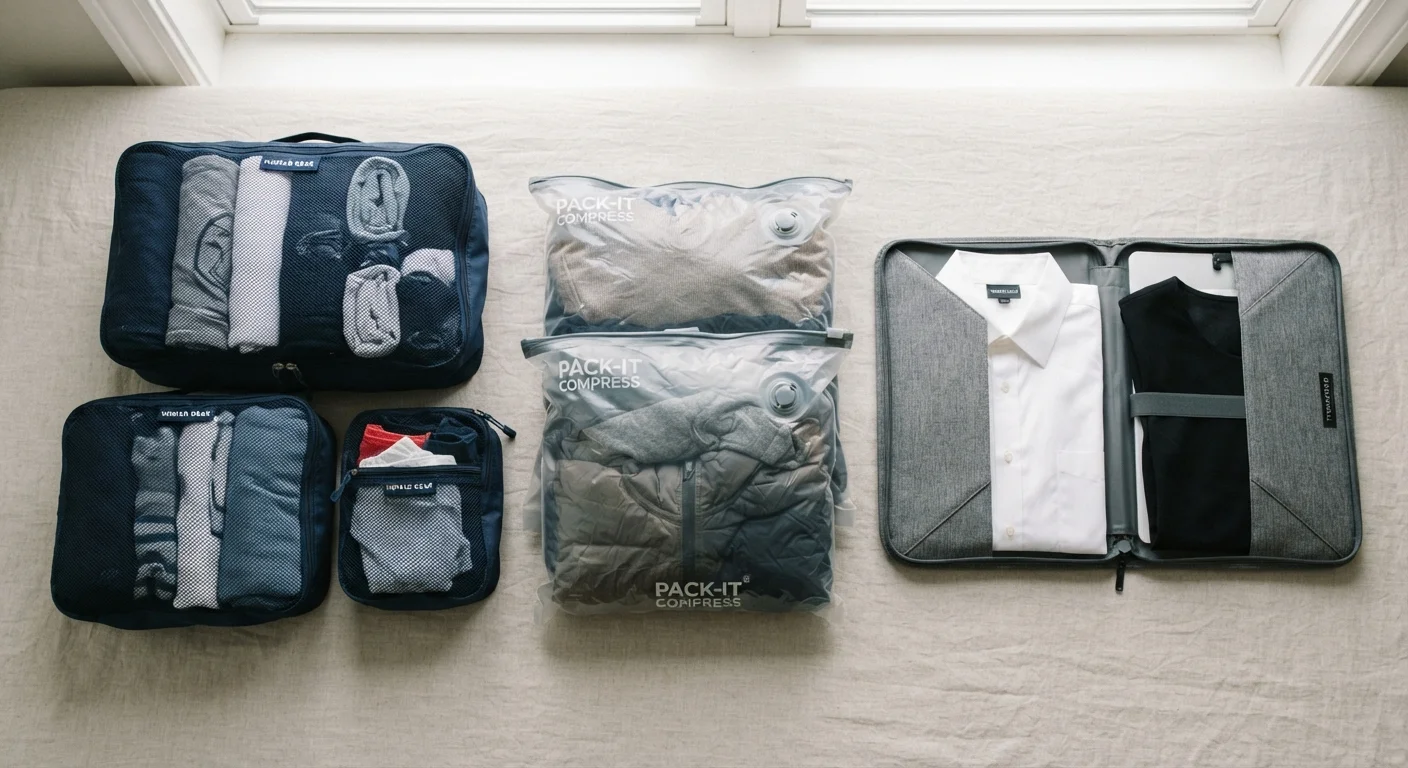
Not all packing organizers work the same way. Here is how packing cubes, compression bags, and folder-style organizers each perform across trip types.
Our Verdict
Each organizer type solves a different problem. Packing cubes are the most flexible daily tool for most trip types. Compression bags earn their place on long trips with bulky cold-weather gear. Folder organizers address wrinkle prevention specifically, and nothing else does that job as well.
| Best for | Recommended |
|---|---|
| Everyday trips with mixed clothing types | Packing cubes |
| Trips requiring heavy or bulky cold-weather items | Compression bags |
| Business travel or any trip where dress clothes must arrive neat | Folder organizers |
| Carry-on-only travel with a capsule wardrobe | Packing cubes |
Key takeaways
- Packing cubes organize without reducing volume; compression bags reduce bulk at the cost of wrinkles.
- Folder organizers work best for dress shirts and slacks that must arrive unwrinkled.
- No single organizer type suits every trip; many travelers use two types together.
- Compression bags can stress zipper seams on softer luggage if overfilled.
- Carry-on travel benefits most from packing cubes or folder organizers, not compression bags.
What each organizer actually does
Packing cubes are zippered fabric pouches that divide the interior of a bag into zones. They do not compress clothing; they contain it. The value is retrieval speed and structural order: you can pull out one cube without disturbing the rest. Cubes come in several sizes, and most travelers use a mix to separate tops, bottoms, and accessories.
Compression bags work by forcing air out of the bag before sealing it, either through a one-way valve or a zip-seal mechanism. The result is a denser, flatter package. That reduction in loft is useful for down jackets, fleece, and thick sweaters, but the same pressure that shrinks a puffer jacket creases cotton dress shirts.
Folder organizers, sometimes called packing folders or flat folders, sandwich garments between rigid or semi-rigid panels and fold them in a single, controlled crease. The goal is to arrive with fewer wrinkles than rolling or cube-packing produces. They are flat and wide, so they suit suitcases better than backpacks.
How they compare across common scenarios
| Criterion | Packing cubes | Compression bags | Folder organizers | |
|---|---|---|---|---|
| Volume reduction | None | High (30-50% for lofty items) | None | |
| Wrinkle prevention | Neutral | Poor | Good | |
| Best fabric type | Any | Synthetics, down, fleece | Dress shirts, trousers, blazers | |
| Retrieval ease | High | Low (must re-compress) | Medium | |
| Carry-on suitability | High | Low to medium | Medium | |
| Weight added | Light (1-3 oz each) | Medium (2-4 oz each) | Heavy (6-10 oz each) | |
| Works in backpacks | Yes | Yes | No (too wide) | |
| Reusability mid-trip | Easy | Cumbersome | Easy |
For carry-on-only travel, volume is the binding constraint. Compression bags can seem appealing here, but the space they save often goes back to the bag as structural slack rather than usable room, because carry-on dimensions are fixed. Packing cubes give you predictable structure inside a compact bag without adding weight.
On a cruise, where you typically have checked luggage allowance and formal nights, a folder organizer for dress clothes combined with packing cubes for casual wear covers both needs. See the cruises planning hub for more on managing luggage across port-heavy itineraries.
Wrinkle performance and fabric compatibility
Wrinkle outcomes depend on fabric type as much as packing method. Synthetic travel fabrics resist creasing under almost any method. Cotton and linen wrinkle readily; compression makes this worse. Wool falls between the two.
If wrinkle prevention matters, the folder organizer is the most reliable tool. Rolling is a reasonable second for casual fabrics. Packing cubes are neutral on wrinkles because they do not compress; the outcome depends on how you fold before placing clothes inside. For a deeper look at folding versus rolling, the rolling vs. folding comparison covers fabric-specific results.
Mixing organizer types works well
Many travelers use packing cubes for casual items and add a folder organizer only for the one or two garments that must arrive unwrinkled. This avoids carrying the full weight of a folder for an entire trip when only a few pieces need wrinkle protection. Compression bags, if you include them at all, are best reserved for a single bulky layer like a down jacket rather than used throughout the bag.
Weight and packability of the organizers themselves
Packing cubes add roughly 1 to 3 ounces each depending on size and material. A set of three or four cubes adds around half a pound to your packed weight, which matters on flights with strict carry-on weight limits.
Compression bags are heavier than they look because the valve and zip-seal mechanisms add material. A single large compression bag can weigh 2 to 4 ounces. When empty, they do not pack down small, which makes them awkward to store during a trip once you have unpacked.
Folder organizers are the heaviest option per garment capacity. A full-size folder that holds four to six shirts typically weighs 6 to 10 ounces. That weight is fixed whether the folder is full or half-empty, so they are most efficient when used at capacity.
Travelers who want to pack lighter often find that organizer weight is worth auditing alongside clothing weight.
The content on this site is for informational purposes only and is not a substitute for professional advice. Always consult a qualified professional for guidance specific to your situation.