
Leash Reactivity in Dogs: Why It Happens and How to Address It

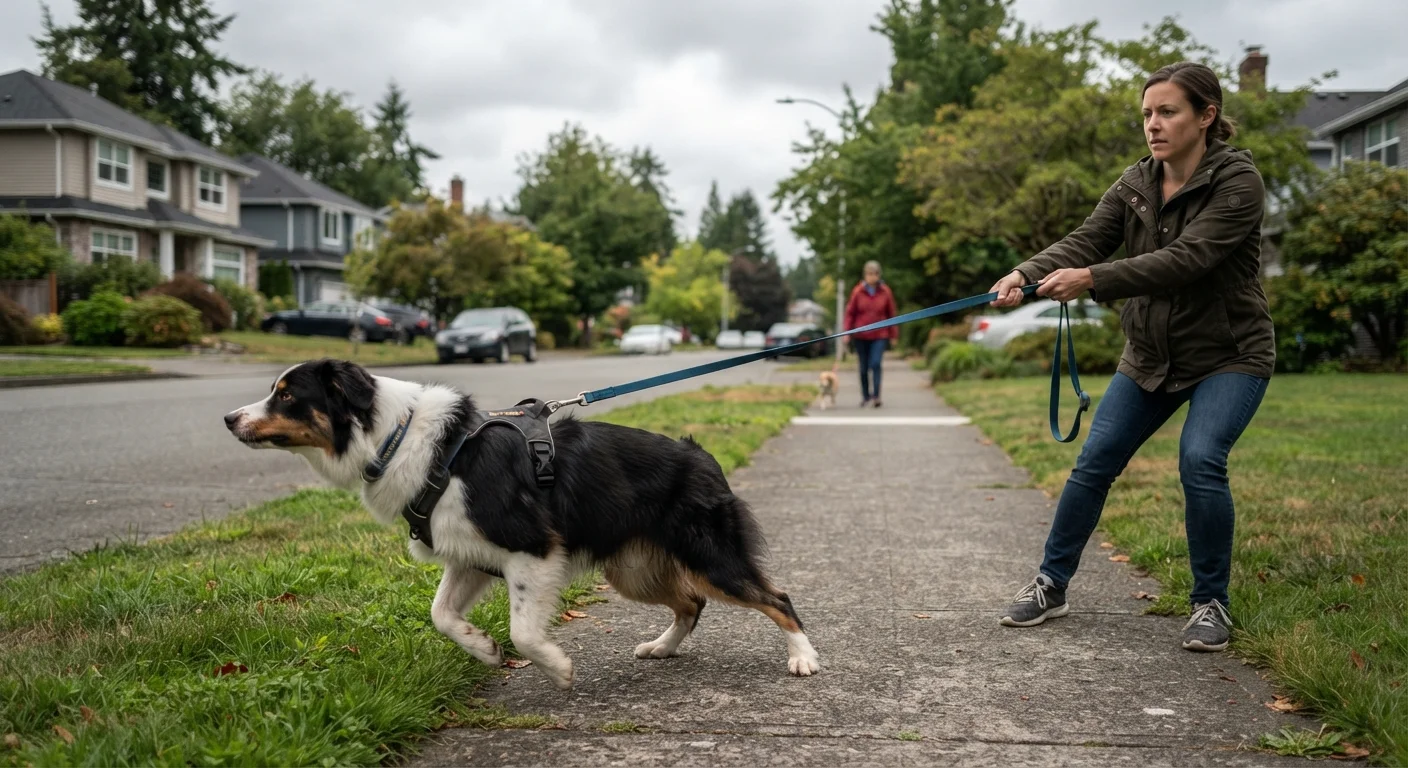
Lunging, barking, or pulling at other dogs on a leash is a common frustration. Learn what drives reactive behavior and what training approaches can help.
Key takeaways
- Leash reactivity is usually driven by frustration or fear, not aggression or disobedience.
- The leash removes a dog's ability to approach or escape freely, which amplifies their emotional response.
- Counter-conditioning and desensitization are the training methods with the strongest behavioral science support.
- Keeping the dog under their 'threshold' (the point where they stop thinking clearly) is central to every effective session.
- Progress is gradual; consistent short sessions build more lasting change than occasional intensive ones.
- A veterinary behaviorist or certified applied animal behaviorist can help when reactivity is severe or not improving.
What is actually happening when a dog reacts on leash
When a dog barks and lunges at another dog while on leash, the behavior looks alarming, but the cause is usually straightforward. The leash removes two of the dog's normal options: approach freely to investigate, or move away to create distance. When both options are blocked, the dog's stress or excitement has nowhere to go except outward. The result is the over-the-top display most owners dread.
Two emotional states account for the majority of reactive behavior. The first is frustration: a social, excitable dog who desperately wants to reach the other dog and cannot. The second is fear or anxiety: a dog who finds the approaching trigger threatening and, unable to flee, defaults to 'make it go away' behavior. Some dogs oscillate between both states depending on the situation.
Recognizing which state is driving your dog helps a lot. A dog reacting from excitement typically has a loose, forward-leaning body with a wagging tail. A dog reacting from fear often shows a tucked tail, hackles up, or attempts to back away before the lunge. Body language is discussed in more detail in the next section.
Reading your dog's body language before the reaction starts
Reactive outbursts rarely appear from nowhere. Dogs broadcast stress signals before they escalate, and learning to spot them gives you time to act. Common early signals include: a stiffening of the body, a fixed stare at the trigger, a high tail held rigid, or lip licking and yawning in a context where those seem out of place.
The concept of a 'threshold' describes the line between a dog who is aware of a trigger but still able to think and respond to cues, and a dog who has passed into full reactivity. Above threshold, a dog cannot learn effectively because the emotional brain is running the show. All productive training happens below threshold, meaning at a distance or intensity where the dog notices the trigger but stays composed.
If your dog already knows basic cues but stops responding to them the moment another dog appears, that is a clear sign the trigger is pushing them over threshold. Understanding why dogs stop responding to cues in high-distraction situations is a useful starting point before beginning reactivity work.
Practice 'find it' as an emergency redirect
Teaching your dog to sniff the ground on cue ('find it,' said as you scatter treats behind you) gives you a fast, calming redirect when a trigger appears suddenly. Sniffing activates the parasympathetic nervous system and lowers arousal quickly. Practice it at home first so the behavior is reliable before you need it on a walk.
Training approaches that work: counter-conditioning and desensitization
Counter-conditioning pairs the trigger with something the dog finds genuinely good, typically a high-value food reward, so the emotional response gradually shifts. The dog begins to associate 'other dog appears' with 'something good happens,' rather than with frustration or threat. Desensitization means starting at a distance or intensity where the dog stays calm and very slowly decreasing that distance over many sessions.
These two methods are used together in practice. A session might look like this: position yourself far enough from a walking area that your dog can see other dogs pass but stays relaxed. The moment a dog appears in view, begin feeding small, high-value treats continuously until the trigger is gone, then stop. Over time, across many repetitions, you can work at smaller distances as the dog's emotional response changes.
Consistency across sessions matters more than session length. Building a training routine that fits your schedule is worth reading alongside this, since short daily exposure practice produces more durable change than occasional long outings. Before each session, checking the conditions that affect your dog's ability to learn, such as how tired or aroused they already are, can improve results significantly. The training session readiness checklist covers those factors in a practical format.
When professional help makes sense
Not every case of leash reactivity responds to owner-led training alone. Dogs with a history of trauma, including many rescue dogs who carry past negative experiences, may have reactivity patterns that are more deeply rooted. A gradual, fear-free approach for rescue dogs addresses this specific situation.
If reactivity is intense (dog makes contact, breaks equipment, or shows escalating behavior over months of consistent work), a consultation with a veterinary behaviorist or a certified applied animal behaviorist is appropriate. These professionals can assess whether anxiety is a factor that would respond to behavioral medicine in combination with training, and they can design a protocol specific to your dog. This is general guidance; any decisions about your individual dog's behavior and care should involve a qualified professional who can observe the dog directly.
Leash reactivity that co-occurs with other signs of anxiety, such as destructive behavior when left alone or excessive vocalization, may point to a broader picture. Separation anxiety and behavior modification outlines how structured desensitization applies to that related pattern.
This article is for general informational purposes only and is not a substitute for professional veterinary or animal behavior advice. Consult a qualified professional for guidance specific to your dog's situation.
Frequently Asked Questions
The content on this site is for informational purposes only and is not a substitute for professional advice. Always consult a qualified professional for guidance specific to your situation.